A good espresso machine helps, but your daily routine determines how much control you truly have. In this Top 10, you'll find practical barista tools that make an immediate difference at home: weighing, keeping beans fresh, frothing milk, working cleanly, and organizing your coffee corner logically.
Not random gadgets, but a sensible basic selection for home baristas who want to make more consistent espresso and cappuccino.
What are essential barista tools for home?
Essential barista tools are the accessories that make your daily coffee routine more controllable. Not because more tools automatically make better coffee, but because the right tools help to reduce guesswork.
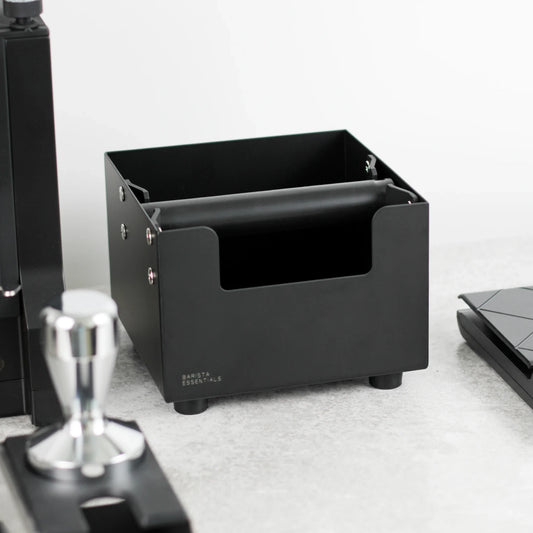
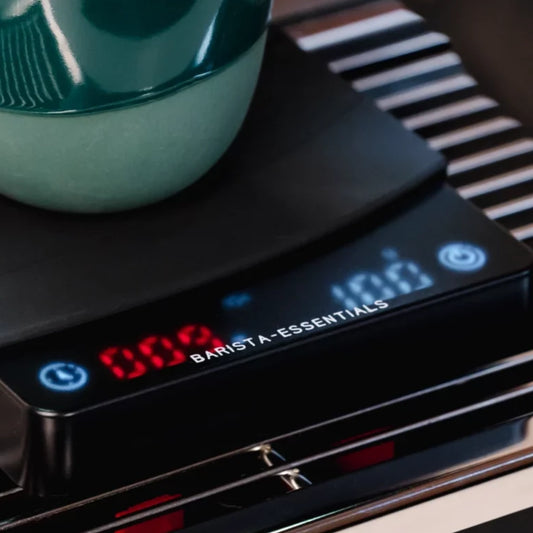
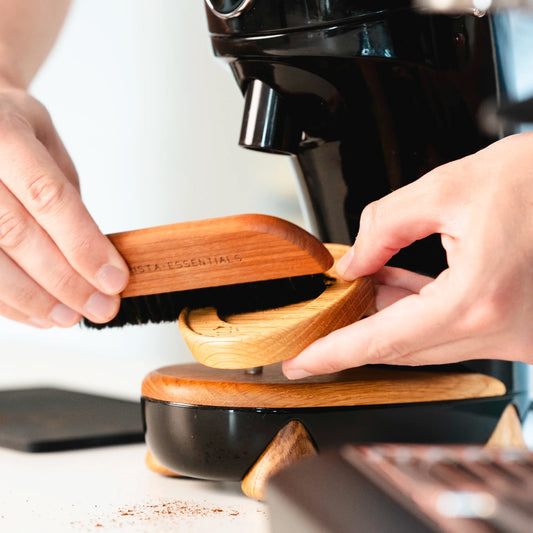
In this selection, you'll find tools for five important parts of your home barista routine: choosing and storing coffee beans, precise weighing, frothing milk, working cleanly, and keeping your coffee corner tidy. Think of a coffee scale with a timer, a vacuum storage container, a milk frothing pitcher, a knock box, cleaning tools, and practical maintenance products.
Do you want to better understand why espresso at home sometimes tastes sour, bitter, or inconsistent? Start with the free introduction to Espresso Under Control.
Why this Top 10 makes sense for home baristas
Many home baristas start with an espresso machine and coffee grinder, but then lack the basics to make their routine repeatable. Making espresso quickly becomes a guessing game: today your shot runs well, tomorrow too fast, then too bitter or too flat.
This collection is compiled based on practice: what helps you gain more control every single day?
A coffee scale helps you better track input, output, and time. A storage container helps you store your beans better. A milk pitcher gives more control for cappuccino and latte art. A knock box, cloths, brush, and cleaning products ensure your machine and workspace stay clean. That sounds simple, but it's precisely these basics that often make the difference at home.
Do you specifically want to learn how to work with weight, flow time, and extraction? Then also check out the online modules of Espresso Under Control.
Who is this collection for?
This Top 10 is for home baristas who use an espresso machine and find that their routine isn't stable enough yet.
This collection is especially suitable for you if:
- you just bought an espresso machine;
- you want to make better espresso or cappuccino at home;
- you still often work by feel instead of with fixed ratios;
- your coffee corner gets messy during brewing;
- you want to better maintain your machine and grinder;
- you are looking for practical tools without having to research everything individually.
If you're already more advanced and want to expand by component, you can then move from this base to the full barista tools collection.
What to choose first?
Don't start with everything at once. First choose the tool that solves the biggest problem in your routine.
If your espresso consistently tastes different, start with a coffee scale with a timer. This will finally show you what you're doing with dosage, yield, and time.
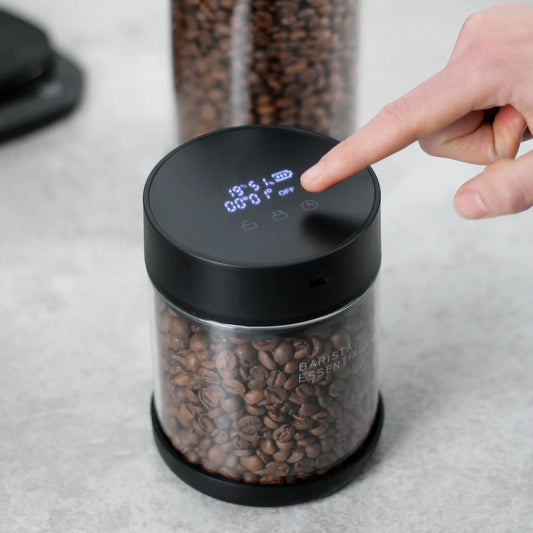
If your coffee beans quickly taste flat or stale, look for a good vacuum storage container. Fresh beans don't stay good on their own; air, light, and moisture are not friends of flavor.
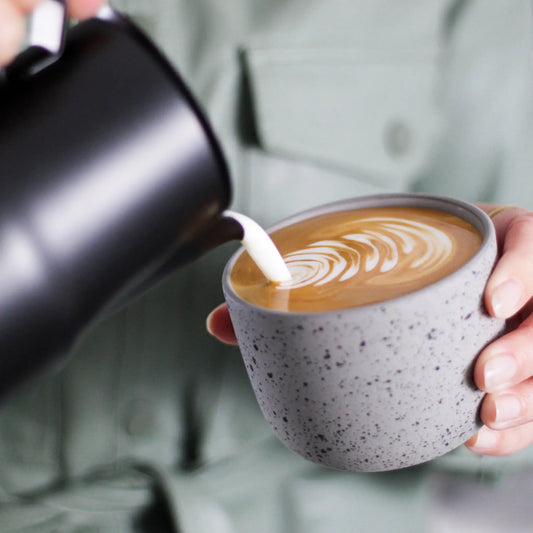
If you want to improve your cappuccino or flat white, choose a milk frothing pitcher that pours well and allows you to feel the milk temperature accurately.
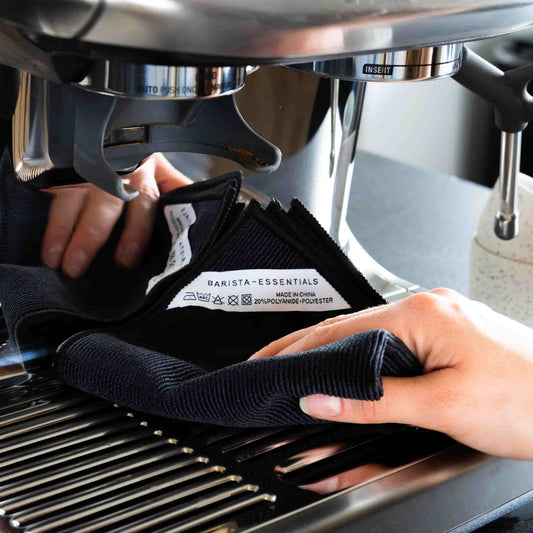
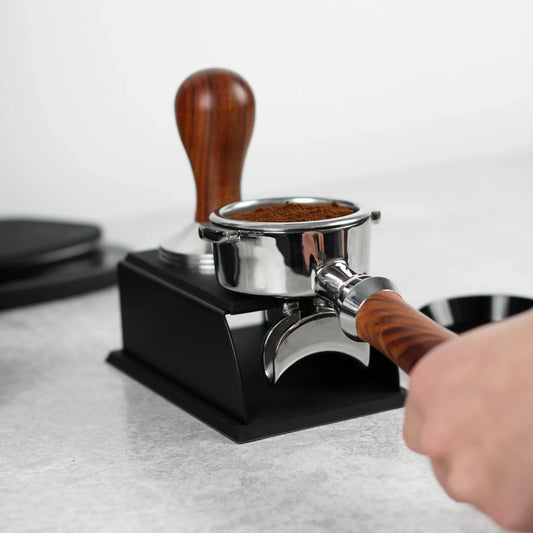
If your coffee corner is covered in coffee grounds after every espresso, start with a knock box, cloths, and a coffee brush.
If you notice that your grinder or machine is deteriorating in taste, take cleaning seriously. Coffee residues and oils build up faster than many home baristas think.
For those primarily looking for extraction control, the collection of espresso scales is a logical next step.
Why The Barista Shop?
The Barista Shop doesn't just look at products, but at what a home barista needs in practice. From barista workshops, Geert-Jan consistently sees the same problems: no fixed ratios, inconsistent beans, insufficient cleaning, milk that doesn't froth well, and a routine that varies every day.
Therefore, a tool should not only be beautiful but also have a clear function. Does it help you weigh? Does it help you work cleaner? Does it help you store your beans better? Does it help you control your milk better? Then it belongs in a basic routine.
This collection is not a collection of random gadgets, but a practical starter kit for more control over your coffee.
Combine these tools with learning and understanding
Tools don't solve everything. A coffee scale only truly helps if you know what you're measuring. A milk pitcher only works well if you understand how microfoam is created. And cleaning only becomes logical when you realize how much influence old coffee residues have on taste.
That's why this collection works best in combination with learning. Use the tools to make your routine more stable, and use the online modules to better understand what's happening in your cup.
If you don't just want to buy things, but really learn to work better with your own espresso machine, then a private home barista workshop is the most direct route.
Personal help with your espresso machine
Are you struggling with your espresso, grind, milk, or workflow? Then personal guidance can be more effective than buying another new tool.
During a private home barista workshop, you work with your own espresso machine, your own coffee grinder, and your own coffee corner. This allows you to immediately see what can be improved: from grind and dosage to tamping, flow time, milk frothing, and clean working.
This also makes this collection useful as preparation for a workshop. You'll already see which basic tools belong in a good home barista routine.
Advice from The Barista Shop
My advice: don't just buy the most expensive or eye-catching tool. Start with control.
For espresso, a good scale is often more important than an extra gadget. For taste, fresh coffee and good storage are more important than a fancy accessory. For daily enjoyment, a clean, calm workspace is more important than an overcrowded coffee corner.
So see this Top 10 as a practical basis. You don't have to get everything at once. First choose the tool that solves your biggest frustration, and then calmly expand your routine.
Frequently asked questions about essential barista tools
What barista tools do you really need at home?
For a good foundation, you primarily need tools that make your routine controllable: a coffee scale with a timer, a milk frothing pitcher, a knock box, a cloth, a brush, cleaning products, and a good way to keep coffee beans fresh. Depending on your machine, you can later expand with size-specific tools like a tamper, dosing ring, puck screen, or WDT tool.
Should I, as a beginner, immediately buy all barista tools?
No. Start with the tools that have the most impact on your daily routine. For espresso, that's usually a scale with a timer. For cappuccino, a good milk pitcher is important. For maintenance, cloths, a brush, and cleaning are essential. You don't have to fill your coffee corner all at once.
Why is a coffee scale so important for espresso?
A coffee scale helps you track dosage, yield, and flow time. Without a scale, you're mostly working by feel. With a scale, you can repeat what went well and correct what didn't.
Do I need a vacuum storage container for coffee beans?
A vacuum storage container is especially useful if you want to better protect your beans from air and moisture. Fresh coffee beans gradually lose aroma after opening. Good storage helps you enjoy your coffee longer.
Which milk pitcher should I choose for cappuccino or latte art?
For one cappuccino, a milk pitcher of approximately 350 ml is often practical. For two cappuccinos or larger milk drinks, a larger pitcher is more convenient. Pay particular attention to control: a good spout, comfortable shape, and thin walls help with milk frothing and pouring.
Why are cleaning tools also included in this Top 10?
Because taste is not only determined by beans and technique. Old coffee residues, oils, and milk residues can affect your espresso and machine. Cleaning is not a side issue, but part of making better coffee.
What's the difference between this collection and all barista tools?
This collection is a compact Top 10 with practical basic products for home baristas. The "All barista tools" collection is much broader and also contains more specific accessories, variants, and size-specific products. Use this Top 10 as a starting point and then delve deeper.
With the right barista tools, making coffee at home becomes more manageable, cleaner, and more consistent. This collection helps you choose which accessories truly add value to your daily espresso machine routine. From coffee scale and milk frothing pitcher to storage container, knock box, cleaning cloths, and maintenance products: each tool has a clear function.
The collection is primarily intended for home baristas who want to make better espresso or cappuccino without getting lost in individual gadgets. Start with control, work cleaner, store your beans better, and gradually learn to understand what's happening in your cup.