Portafilters for espresso machines

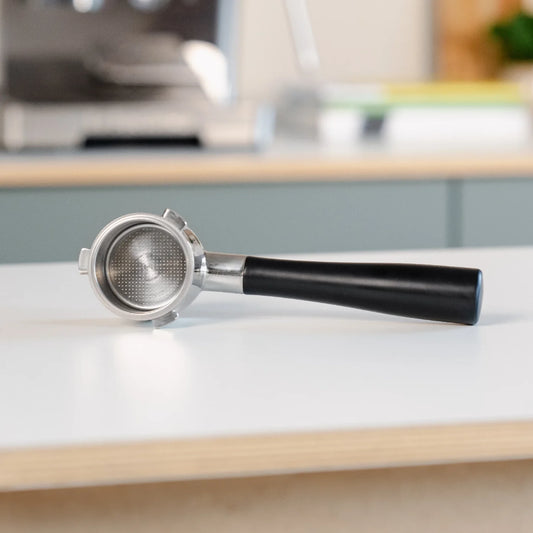
A portafilter is more than just a handle with a filter basket. It's where your dosing, distribution, tamping, and extraction all come together.

In this collection, you'll find portafilters and filter holders from Barista Essentials for various espresso machines. Choose from naked portafilters for visual feedback, double spout portafilters for cleaner pouring, and wall mounts to keep your coffee corner tidy. Always pay close attention to the correct size and compatibility with your machine.

Buying a Portafilter for Your Espresso Machine

A portafilter, also known as a filter holder, piston, or coffee filter holder, is one of the most important parts of your espresso machine. You fill the filter basket with ground coffee, distribute the coffee, tamp the puck, and place the portafilter in the group head. After that, the combination of grind, dosage, puck prep, and pressure determines how your espresso flows.

This collection is made for home baristas looking for a suitable portafilter for their machine. Think of naked portafilters, double spout portafilters, and handy wall mounts for your coffee corner. The most important question isn't: which portafilter looks the best? The most important question is: which portafilter suits your machine, your workflow, and your way of making espresso?

Also, check out the broader collection of barista tools for your espresso machine

Naked Portafilter or Double Spout: Which do you choose?

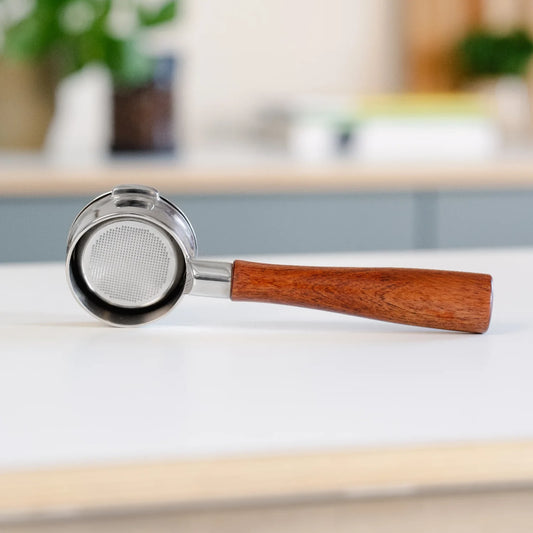
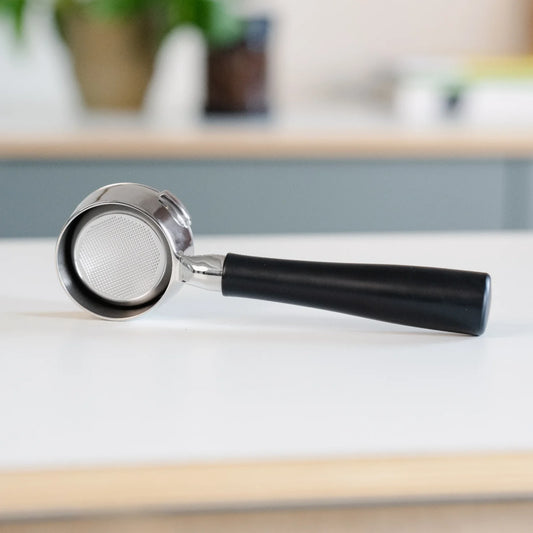
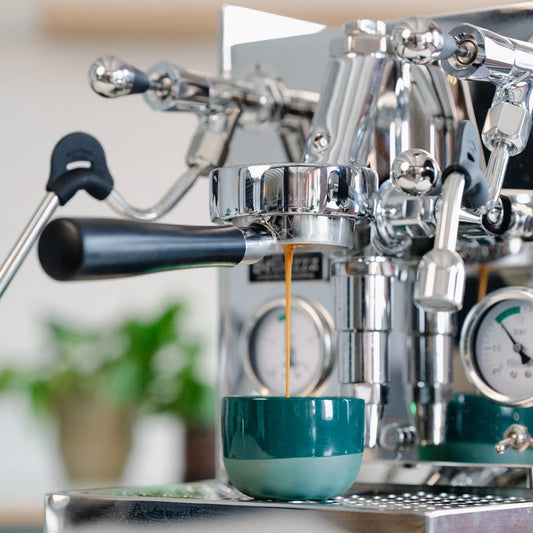
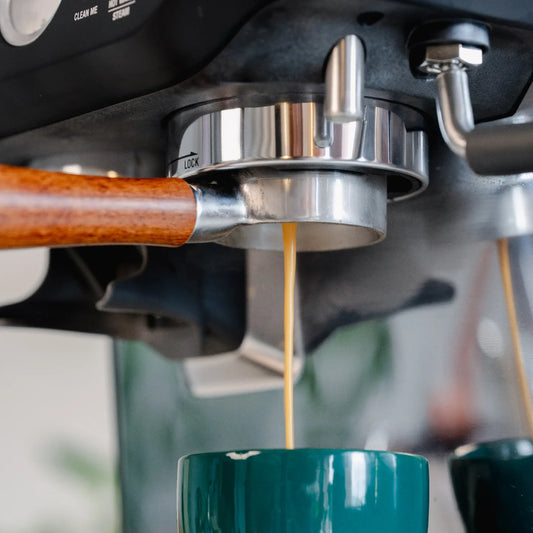
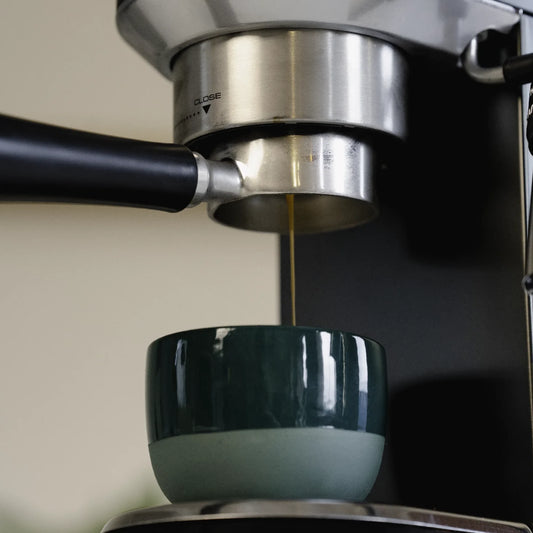
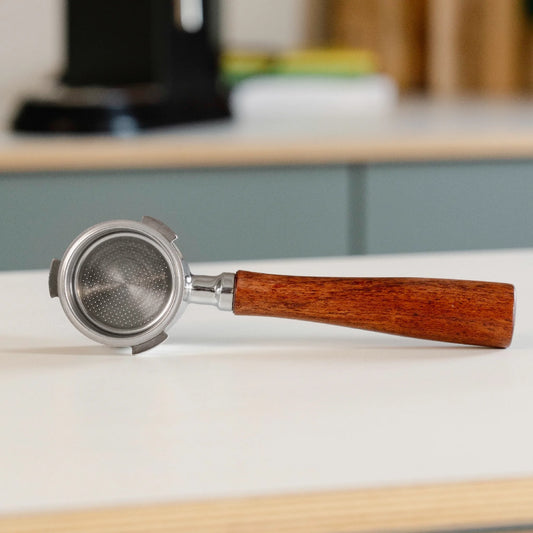
A naked portafilter, also known as a bottomless portafilter, has no base or spout. This allows you to directly see how the espresso flows from the filter basket. This is useful if you want to learn to identify channeling, uneven extraction, uneven distribution, or errors in your puck prep.

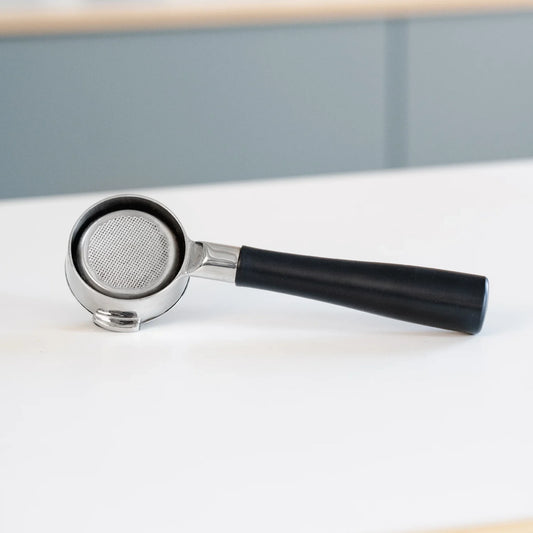
A double spout portafilter is more practical if you want to pour espresso neatly into one or two cups. You see less of the extraction itself, but you work more calmly and cleanly. For daily use, a double spout can therefore be more pleasant than a naked portafilter.

My advice: choose a naked portafilter if you want to learn and analyze. Choose a double spout portafilter if you mainly want to make espresso neatly and practically.

Also, read the blog about a spraying naked portafilter

Pay attention to the correct size: 51, 54 or 58 mm

The biggest mistake when buying a portafilter is choosing the wrong size. A portafilter must not only have the same diameter but also fit the group head of your machine. The shape of the ears, the locking mechanism, and the machine type are important here.

Many De'Longhi machines use 51 mm, many Sage machines use 54 mm, and many E61 machines, Gaggias, Bezzeras, and prosumer machines use 58 mm. But beware: diameter alone is not always enough. Always check that the product variant is specifically suitable for your brand and model.

Are you unsure between 51, 54, or 58 mm? Then don't buy on instinct, but first check your machine, portafilter, and product information. A portafilter that doesn't quite fit will lead to frustration instead of better coffee.

Why a different portafilter doesn't automatically make your espresso better

A new portafilter can improve your workflow, but it won't fix bad espresso. If your grind is incorrect, your coffee is poorly distributed, you tamp unevenly, or your dosage doesn't match your filter basket, your espresso will remain inconsistent.

A naked portafilter makes these errors more visible. A double spout portafilter makes your pouring routine tidier. But better espresso comes from the entire chain: fresh beans, correct grind, consistent dosing, good distribution, flat tamping, appropriate extraction time, and regular maintenance.

Want to learn how these steps are interconnected? Start with the free introduction to Espresso Under Control.

Portafilter, filter basket, and dosing belong together

A portafilter works with the filter basket you use. An 18-gram filter basket requires a different dose than a smaller or larger basket. Too much coffee can result in too little space above the puck. Too little coffee can lead to a thin, unstable puck.

Therefore, it's smart not to just look at the portafilter itself, but also at your recipe. How many grams of coffee do you use? How much espresso comes out? How long does the extraction take? And is your result repeatable?

If you're serious about espresso, you don't use a portafilter independently of your routine. You use it as part of your complete espresso recipe.

Combine your portafilter with the right puck prep tools

A portafilter is only truly useful if you prepare the coffee in the filter basket correctly. For this, you need a suitable tamper. The tamper must match the size of your filter basket so that you can press the puck evenly without leaving large gaps around the edges.

Are you using a naked portafilter and seeing splattering, multiple streams, or uneven flow? Then the problem often lies not with the portafilter itself, but with the preceding steps: grinding, dosing, distributing, and tamping.

Therefore, also check out the collection of espresso tampers in different sizes.

Improve your distribution before tamping

A WDT tool helps to break up clumps in your grind and distribute the coffee more evenly in your filter basket. Especially with naked portafilters, you quickly see if your distribution is messy. Poor distribution can lead to channeling, splattering, and erratic extraction.

Do you want to guess less and have more control over your puck prep? Then first use a WDT tool or coffee distributor, and then tamp flat and gently.

Also, check out coffee distributors and combination tools

Work cleaner with a dosing funnel

A dosing funnel is useful if you want to keep ground coffee neatly in your portafilter. Especially with smaller filter holders or full filter baskets, coffee can quickly spill over the edge. This makes your workspace messy and your dosing less precise.

A dosing funnel primarily helps with grinding, distributing, and working with WDT. You prevent mess and keep your puck prep calmer. This doesn't make it a miracle cure, but it is a practical tool for a tidier espresso workflow.

Complete your coffee corner logically

After making espresso, the used puck also needs to be removed from your portafilter. For this, you use a knock box, knock bin, or knock drawer. This keeps your coffee corner cleaner and prevents you from tapping your portafilter against a trash can, sink, or fragile surface.

Do you use multiple portafilters, for example, a standard double spout and a naked portafilter? Then a wall mount can be handy to keep your coffee corner organized.

A portafilter is therefore part of a broader routine: grinding, dosing, distributing, tamping, brewing, knocking out, and cleaning.

Don't forget maintenance

A portafilter comes into daily contact with coffee, oils, moisture, and heat. Therefore, rinse your filter holder and filter basket regularly and prevent old coffee residues from affecting your taste.

Do not use a normal dishwashing routine as a substitute for proper coffee machine maintenance. For espresso, the group head, filter basket, portafilter, and spout are sensitive areas where coffee residues can accumulate. Cleanliness not only makes your coffee tidier but often noticeably better.

Truly understand your espresso

At De Barista Shop, it's not just about buying more tools. A portafilter, tamper, WDT tool, or dosing funnel is only valuable if you understand what you're doing with it.

That's why this collection fits into the larger Espresso Under Control system. You learn step-by-step how beans, grind, dosing, distribution, tamping, extraction, and maintenance together determine what happens in your cup.

So don't just buy a new portafilter because your espresso is disappointing. Use this collection to choose the right filter holder, but at the same time learn why your espresso behaves the way it does.

Personal help with your machine and portafilter

Do you continue to struggle with channeling, sour espresso, bitter espresso, incorrect extraction times, or doubt about your portafilter size? Then personal guidance is often faster than continuing to guess.

During a private barista workshop at home, you work with your own espresso machine, your own grinder, your own portafilter, and your own beans. This allows you to directly see where your routine can be improved.

Advice from The Barista Shop

Don't choose a portafilter based solely on its appearance. Wood or black handle is a matter of taste. Naked or double spout is workflow. 51, 54, or 58 mm is fit. And fit is paramount.

Do you want to learn? Choose a naked portafilter. Do you want to pour more neatly? Choose a double spout. Do you want to organize your coffee corner more efficiently? Use a wall mount. But don't expect a portafilter alone to solve your espresso problems.

The right portafilter helps you work better. The right knowledge helps you make better coffee.


Frequently Asked Questions about Portafilters

What is a portafilter?

A portafilter is the filter holder of your espresso machine. You place a filter basket in it, fill it with ground coffee, tamp the coffee, and click the portafilter into the group head of your machine.

What is the difference between a portafilter and a filter holder?

There is practically no difference. Portafilter, filter holder, piston, and coffee filter holder are often used interchangeably for the same part of an espresso machine.

What is the difference between a naked portafilter and a double spout portafilter?

A naked portafilter has no bottom or spout, allowing you to directly see the extraction. A double spout portafilter neatly divides the espresso into one or two cups and is often more practical for daily use.

What size portafilter do I need?

That depends on your espresso machine. Many De'Longhi machines use 51 mm, many Sage machines use 54 mm, and many E61 machines, Gaggias, Bezzeras, and prosumer machines use 58 mm. Always check the specific model.

Will every 58 mm portafilter fit every 58 mm machine?

No. The diameter is important, but not enough. The ears, locking mechanism, and shape of the portafilter must also fit your group head. Therefore, always choose a portafilter that is suitable for your brand and machine type.

Will a new portafilter make my espresso better?

Not automatically. A portafilter can improve your workflow or make your extraction more visible, but better espresso comes from the combination of beans, grind, dosing, distribution, tamping, extraction, and maintenance.

Why does my naked portafilter spray?

Spraying often indicates channeling. This means that water finds an easy path through the coffee puck. Possible causes include clumps, poor distribution, incorrect grind, uneven tamping, or a dose that does not fit your filter basket.

When should I choose a double spout portafilter?

Choose a double spout portafilter if you want to pour more neatly, often make two espressos at once, or have less need for visual feedback on the extraction.

When should I choose a naked portafilter?

Choose a naked portafilter if you want to learn to observe your extraction. You will immediately see if the espresso comes together calmly or if there is channeling, splattering, or uneven flow.

Do I need other tools besides a portafilter?

Yes, usually. Think of a suitable tamper, possibly a WDT tool or coffee distributor, a dosing funnel, a knock box, and good cleaning products. A portafilter always works within your total espresso routine.

Choose a filter holder for a specific action

First, choose how you want to collect the coffee

A double spout divides the coffee into two streams. You can place a cup under each spout or collect both streams in one sufficiently wide cup. A naked portafilter does not have those two spouts: with it, you can view the bottom of the filter basket. Both solve a different question. The taste also depends on the beans, grind, and preparation.

Double spout: check these connections

The link below goes to the wooden version on our own product page; black is a different finish within the same machine family. Check the full model name and the lugs, not just the millimeter size.

51 mm Dedica: Dedica, except Maestro Plus, and SMEG ECF01/ECF02. Wood and black are finishes within this machine version.

51 mm Silvercrest: Silvercrest SEM 1100 and SEMM 1470; De’Longhi Linea Classic, Severin Espresa, Gastroback Piccolo, Princess, Graef Salita and AEG EC6 are also compatible with this connection. Wood and black are finishes within this machine version.

54 mm Sage: Barista Express, Barista Pro, Barista Touch, Bambino and Solis Grind & Infuse Pro. For a different basket, check the combination with the cup beforehand. Wood and black are finishes within this machine version.

58 mm Bezzera BZ: BZ10, BZ09, BZ13 and BZ07. Another Bezzera is not automatically confirmed with this. Wood and black are finishes within this machine version.

58 mm E61: Flair 58, Rocket, Vibiemme Domobar, Rancilio, Ascaso, ECM and Quick Mill. Quick Mill with three fins, such as 820, 3000 and 3004, falls outside this fit. Use the own version for the Bezzera BZ and La Marzocco models mentioned below. Wood and black are finishes within this machine version.

58 mm SMEG: SMEG ECF03, EGF03 and Gastroback Barista Pro; this is not the version for SMEG ECF01/ECF02. Wood and black are finishes within this machine version.

58 mm Gaggia: Classic, Classic Evo, Classic Pro, Baby and New Classic. Wood and black are finishes within this machine version.

58 mm La Marzocco: The supplier lists the La Marzocco models except Micra. This version is not suitable for Micra. Wood and black are finishes within this machine version.

Naked: choose from the own machine versions

The open portafilters are listed as separate choices among the main products. For Solis and for machines with different lugs, the following limitations are important. The separate collection of naked portafilters goes further into watching during brewing.

51 mm Dedica: Dedica, except Maestro Plus, and SMEG ECF01/ECF02. Wood and black are finishes within this machine version.

51 mm La Specialista: La Specialista Prestigio, Arte and Maestro; also Dedica Maestro Plus. This is a different connection than the regular Dedica version. Wood and black are finishes within this machine version.

51 mm Icona Vintage: De’Longhi Icona Vintage; choose this separate version. Wood and black are finishes within this machine version.

51 mm La Pavoni: The variant is named for La Pavoni after 2000. Check the year of manufacture and exact model before ordering; that designation does not confirm a universal fit on every La Pavoni. Wood and black are finishes within this machine version.

51 mm Silvercrest: Silvercrest SEM 1100 and SEMM 1470; De’Longhi Linea Classic, Severin Espresa, Gastroback Piccolo, Princess, Graef Salita and AEG EC6 are also compatible with this connection. Wood and black are finishes within this machine version.

54 mm Sage: Barista Express, Barista Pro, Barista Touch and Bambino. For Solis Grind & Infuse Pro, the supplier lists exclusively the original filter basket for the naked version. Wood and black are finishes within this machine version.

58 mm E61: Flair 58, Rocket, Vibiemme Domobar, Rancilio, Ascaso, ECM and Quick Mill. Quick Mill with three fins, such as 820, 3000 and 3004, falls outside this fit. Use the own version for the Bezzera BZ and La Marzocco models mentioned below. Wood and black are finishes within this machine version.

58 mm Bezzera BZ: BZ10, BZ09, BZ13 and BZ07. Another Bezzera is not automatically confirmed with this. Wood and black are finishes within this machine version.

58 mm Sage: Dual Boiler, Oracle Touch, The Oracle and Solis Triple Heat. This is not a replacement for the 54 mm Sage version. Wood and black are finishes within this machine version.

58 mm Gaggia: Classic, Classic Evo, Classic Pro, Baby and New Classic. Wood and black are finishes within this machine version.

58 mm La Marzocco: The supplier lists the La Marzocco models except Micra. This version is not suitable for Micra. Wood and black are finishes within this machine version.

58 mm SMEG: SMEG ECF03, EGF03 and Gastroback Barista Pro; this is not the version for SMEG ECF01/ECF02. Wood and black are finishes within this machine version.

Material, package contents and space under the machine

The cup is made of stainless steel. The naked versions have a removable filter basket; a filter basket is also offered with the double spout. The handle finish is rosewood or black plastic. Adjust a dose to the actually included or used basket, without assuming a fixed dose for every version. Total length, width, height including handle and spout, and combination height with cup or scale are not confirmed for all variants. Check the free space before ordering; the nominal filter size does not say enough about that.

Accessories with the same portafilter

A shotmirror is optional if you want to watch with a naked portafilter without always looking down next to the machine. The stainless steel mirror is 60 mm in diameter, has a 360° adjustable ball joint and a magnetic base. There are two metal stickers included for a suitable non-magnetic surface. Check the free space and mounting location; total height and base diameter are not confirmed.

A wall holder gives a spare portafilter a fixed place. For the 51 mm holder the supplier lists Dedica and SMEG ECF01/ECF02. For the 58 mm holder La Marzocco, Flair 58, Bezzera, Rocket, Vibiemme Domobar, Rancilio, Ascaso and ECM are listed. There is no suitable 54 mm holder confirmed. Other models cannot be judged on diameter alone. Screws are included; assess the wall and required mounting yourself. The full outer dimensions are not confirmed.

The brown barista cloths are intended for wiping the portafilter: two cloths of 30 × 30 cm, 80% polyester and 20% polyamide. Keep these separate from a cloth for milk residues on the steam pipe. Wash at maximum 40 °C and do not use a dryer. A cloth does not replace a suitable cleaning agent when needed.

If you want to follow the quantity and time during practice, check the separate choice guide for coffee scales. They are not a mandatory additional purchase with another portafilter.

Frequently Asked Questions

Collapsible row

Yes, you can catch both streams in a single cup wide enough. If you want to fill two cups, place one under each spout. Check yourself whether your cups and any scale fit under the chosen filter holder; external dimensions and combined height are not specified here.

Collapsible row

No. The cams and portafilter shape vary by machine family. For both double spout and naked portafilters, several different 58 mm versions are listed on this page, including E61, Bezzera BZ, Gaggia, SMEG, and La Marzocco. The naked portafilter also has its own 58 mm Sage version. Select the full machine model; 58 mm alone does not guarantee compatibility.

Collapsible row

No. You can see the bottom of the filter basket, but the tool does not set your grinder or distribute the coffee for you. Use what you see along with the amount of espresso, the brew time, and the taste.

Collapsible row

No. Wood and black plastic are finishes within a machine version. First choose the connection, and then the handle. A different handle color will not solve an incorrect head or socket shape.

Collapsible row

Not if this one fits well and does what you need. Another version is mainly worthwhile if you are looking for a specific alternative function: two spouts or a clear view under the filter basket. Do not expect an automatic solution for coffee that tastes sour or bitter.

I have another question

Is your question not listed? Contact us. We are happy to help you choose the right product.

Collection: Portafilters for espresso machines

A portafilter is more than just a handle with a filter basket. It's where your dosing, distribution, tamping, and extraction all come together.

In this collection, you'll find portafilters and filter holders from Barista Essentials for various espresso machines. Choose from naked portafilters for visual feedback, double spout portafilters for cleaner pouring, and wall mounts to keep your coffee corner tidy. Always pay close attention to the correct size and compatibility with your machine.

Buying a Portafilter for Your Espresso Machine

A portafilter, also known as a filter holder, piston, or coffee filter holder, is one of the most important parts of your espresso machine. You fill the filter basket with ground coffee, distribute the coffee, tamp the puck, and place the portafilter in the group head. After that, the combination of grind, dosage, puck prep, and pressure determines how your espresso flows.

This collection is made for home baristas looking for a suitable portafilter for their machine. Think of naked portafilters, double spout portafilters, and handy wall mounts for your coffee corner. The most important question isn't: which portafilter looks the best? The most important question is: which portafilter suits your machine, your workflow, and your way of making espresso?

Also, check out the broader collection of barista tools for your espresso machine

Naked Portafilter or Double Spout: Which do you choose?

A naked portafilter, also known as a bottomless portafilter, has no base or spout. This allows you to directly see how the espresso flows from the filter basket. This is useful if you want to learn to identify channeling, uneven extraction, uneven distribution, or errors in your puck prep.

A double spout portafilter is more practical if you want to pour espresso neatly into one or two cups. You see less of the extraction itself, but you work more calmly and cleanly. For daily use, a double spout can therefore be more pleasant than a naked portafilter.

My advice: choose a naked portafilter if you want to learn and analyze. Choose a double spout portafilter if you mainly want to make espresso neatly and practically.

Also, read the blog about a spraying naked portafilter

Pay attention to the correct size: 51, 54 or 58 mm

The biggest mistake when buying a portafilter is choosing the wrong size. A portafilter must not only have the same diameter but also fit the group head of your machine. The shape of the ears, the locking mechanism, and the machine type are important here.

Many De'Longhi machines use 51 mm, many Sage machines use 54 mm, and many E61 machines, Gaggias, Bezzeras, and prosumer machines use 58 mm. But beware: diameter alone is not always enough. Always check that the product variant is specifically suitable for your brand and model.

Are you unsure between 51, 54, or 58 mm? Then don't buy on instinct, but first check your machine, portafilter, and product information. A portafilter that doesn't quite fit will lead to frustration instead of better coffee.

Why a different portafilter doesn't automatically make your espresso better

A new portafilter can improve your workflow, but it won't fix bad espresso. If your grind is incorrect, your coffee is poorly distributed, you tamp unevenly, or your dosage doesn't match your filter basket, your espresso will remain inconsistent.

A naked portafilter makes these errors more visible. A double spout portafilter makes your pouring routine tidier. But better espresso comes from the entire chain: fresh beans, correct grind, consistent dosing, good distribution, flat tamping, appropriate extraction time, and regular maintenance.

Want to learn how these steps are interconnected? Start with the free introduction to Espresso Under Control.

Portafilter, filter basket, and dosing belong together

A portafilter works with the filter basket you use. An 18-gram filter basket requires a different dose than a smaller or larger basket. Too much coffee can result in too little space above the puck. Too little coffee can lead to a thin, unstable puck.

Therefore, it's smart not to just look at the portafilter itself, but also at your recipe. How many grams of coffee do you use? How much espresso comes out? How long does the extraction take? And is your result repeatable?

If you're serious about espresso, you don't use a portafilter independently of your routine. You use it as part of your complete espresso recipe.

Combine your portafilter with the right puck prep tools

A portafilter is only truly useful if you prepare the coffee in the filter basket correctly. For this, you need a suitable tamper. The tamper must match the size of your filter basket so that you can press the puck evenly without leaving large gaps around the edges.

Are you using a naked portafilter and seeing splattering, multiple streams, or uneven flow? Then the problem often lies not with the portafilter itself, but with the preceding steps: grinding, dosing, distributing, and tamping.

Therefore, also check out the collection of espresso tampers in different sizes.

Improve your distribution before tamping

A WDT tool helps to break up clumps in your grind and distribute the coffee more evenly in your filter basket. Especially with naked portafilters, you quickly see if your distribution is messy. Poor distribution can lead to channeling, splattering, and erratic extraction.

Do you want to guess less and have more control over your puck prep? Then first use a WDT tool or coffee distributor, and then tamp flat and gently.

Also, check out coffee distributors and combination tools

Work cleaner with a dosing funnel

A dosing funnel is useful if you want to keep ground coffee neatly in your portafilter. Especially with smaller filter holders or full filter baskets, coffee can quickly spill over the edge. This makes your workspace messy and your dosing less precise.

A dosing funnel primarily helps with grinding, distributing, and working with WDT. You prevent mess and keep your puck prep calmer. This doesn't make it a miracle cure, but it is a practical tool for a tidier espresso workflow.

Complete your coffee corner logically

After making espresso, the used puck also needs to be removed from your portafilter. For this, you use a knock box, knock bin, or knock drawer. This keeps your coffee corner cleaner and prevents you from tapping your portafilter against a trash can, sink, or fragile surface.

Do you use multiple portafilters, for example, a standard double spout and a naked portafilter? Then a wall mount can be handy to keep your coffee corner organized.

A portafilter is therefore part of a broader routine: grinding, dosing, distributing, tamping, brewing, knocking out, and cleaning.

Don't forget maintenance

A portafilter comes into daily contact with coffee, oils, moisture, and heat. Therefore, rinse your filter holder and filter basket regularly and prevent old coffee residues from affecting your taste.

Do not use a normal dishwashing routine as a substitute for proper coffee machine maintenance. For espresso, the group head, filter basket, portafilter, and spout are sensitive areas where coffee residues can accumulate. Cleanliness not only makes your coffee tidier but often noticeably better.

Truly understand your espresso

At De Barista Shop, it's not just about buying more tools. A portafilter, tamper, WDT tool, or dosing funnel is only valuable if you understand what you're doing with it.

That's why this collection fits into the larger Espresso Under Control system. You learn step-by-step how beans, grind, dosing, distribution, tamping, extraction, and maintenance together determine what happens in your cup.

So don't just buy a new portafilter because your espresso is disappointing. Use this collection to choose the right filter holder, but at the same time learn why your espresso behaves the way it does.

Personal help with your machine and portafilter

Do you continue to struggle with channeling, sour espresso, bitter espresso, incorrect extraction times, or doubt about your portafilter size? Then personal guidance is often faster than continuing to guess.

During a private barista workshop at home, you work with your own espresso machine, your own grinder, your own portafilter, and your own beans. This allows you to directly see where your routine can be improved.

Advice from The Barista Shop

Don't choose a portafilter based solely on its appearance. Wood or black handle is a matter of taste. Naked or double spout is workflow. 51, 54, or 58 mm is fit. And fit is paramount.

Do you want to learn? Choose a naked portafilter. Do you want to pour more neatly? Choose a double spout. Do you want to organize your coffee corner more efficiently? Use a wall mount. But don't expect a portafilter alone to solve your espresso problems.

The right portafilter helps you work better. The right knowledge helps you make better coffee.


Frequently Asked Questions about Portafilters

What is a portafilter?

A portafilter is the filter holder of your espresso machine. You place a filter basket in it, fill it with ground coffee, tamp the coffee, and click the portafilter into the group head of your machine.

What is the difference between a portafilter and a filter holder?

There is practically no difference. Portafilter, filter holder, piston, and coffee filter holder are often used interchangeably for the same part of an espresso machine.

What is the difference between a naked portafilter and a double spout portafilter?

A naked portafilter has no bottom or spout, allowing you to directly see the extraction. A double spout portafilter neatly divides the espresso into one or two cups and is often more practical for daily use.

What size portafilter do I need?

That depends on your espresso machine. Many De'Longhi machines use 51 mm, many Sage machines use 54 mm, and many E61 machines, Gaggias, Bezzeras, and prosumer machines use 58 mm. Always check the specific model.

Will every 58 mm portafilter fit every 58 mm machine?

No. The diameter is important, but not enough. The ears, locking mechanism, and shape of the portafilter must also fit your group head. Therefore, always choose a portafilter that is suitable for your brand and machine type.

Will a new portafilter make my espresso better?

Not automatically. A portafilter can improve your workflow or make your extraction more visible, but better espresso comes from the combination of beans, grind, dosing, distribution, tamping, extraction, and maintenance.

Why does my naked portafilter spray?

Spraying often indicates channeling. This means that water finds an easy path through the coffee puck. Possible causes include clumps, poor distribution, incorrect grind, uneven tamping, or a dose that does not fit your filter basket.

When should I choose a double spout portafilter?

Choose a double spout portafilter if you want to pour more neatly, often make two espressos at once, or have less need for visual feedback on the extraction.

When should I choose a naked portafilter?

Choose a naked portafilter if you want to learn to observe your extraction. You will immediately see if the espresso comes together calmly or if there is channeling, splattering, or uneven flow.

Do I need other tools besides a portafilter?

Yes, usually. Think of a suitable tamper, possibly a WDT tool or coffee distributor, a dosing funnel, a knock box, and good cleaning products. A portafilter always works within your total espresso routine.

Twee houten filterdragers met een los onderdeel voor dubbele uitloop op een witte achtergrond