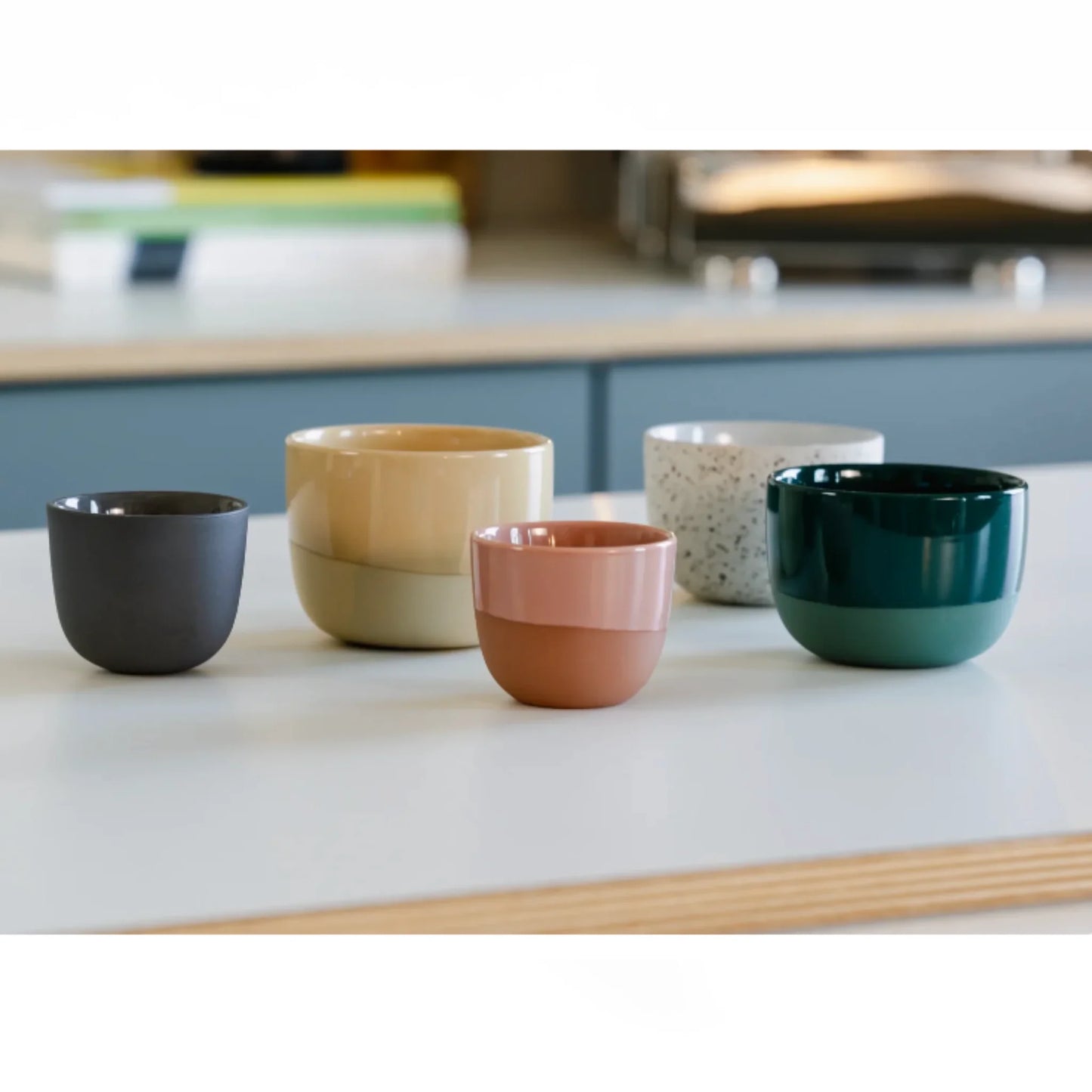
β Latte cup 250 ml Sand Yellow | Barista Essentials
Do you like making a caffΓ¨ latte or a larger cappuccino, but the coffee disappears into a mug thatβs too big? This sand-colored latte cup from Barista Essentials gives you a fixed serving size of 250 ml. The handmade porcelain cup has a semi-glazed finish and room to practice latte art. Discover below if this size suits your coffee. You order directly from Barista Essentials.
- 250 ml for caffè latte and larger cappuccino
- Wide opening with room to pour latte art
- Handmade porcelain in sand yellow, semi-glazed
Affiliate: this link will take you to Barista Essentials, where you will place your order and make payment, and where shipping, returns, warranty, and the right of withdrawal will be handled according to their current terms and conditions. Geert-Jan de Baristaman receives a commission at no extra cost to you.
View full details

Key specifications
-
Brand
Barista Essentials
-
Product type
Latte cup without handle, half glazed
-
Size / Content
Latte cup without handle, half glazed
-
Suitable for
Can be used directly under the spout provided that the height, width, and any scale allow for sufficient space; no specific machine models confirmed. Cup dimensions: 88 mm wide Γ 88 mm deep Γ 65 mm high
-
Material / finish
Porcelain
-
Cleaning / Maintenance
Barista Essentials states that the barista cups are dishwasher safe. In addition, please follow the cleaning instructions provided with the cup.
-
Colour
Sand Yellow β sand yellow (also available in other colors such as green and terracotta)
-
Package contents
1x cup
Why this helps make better coffee
You pull an espresso, froth some milk, and grab a mug from the cupboard. Then you pour until that mug is about full. One time your coffee tastes pleasant and clearly like espresso. The next time, you mostly taste milk. Yet, it feels like you did the exact same thing.
The size of your mug might play an unnoticed role in this. If you use the same amount of espresso but always add a different amount of milk, the ratio in your drink changes. A large mug easily invites you to pour more milk than you actually need. Your coffee then becomes milkier, even if the espresso itself was brewed well.
With latte art, there is another factor. Latte art involves pouring a pattern with frothed milk, for example, a heart. In a tall, narrow mug, it is harder to see what is happening on the surface, and it can be more difficult to bring the spout close to the coffee.
A suitable cup helps you keep track. You always use the same size and can choose more consciously how much espresso and milk you combine. Does your latte still taste sour, bitter, or watery despite those fixed ratios? Then the espresso itself deserves attention. With The 3 Golden Rules of Espressoyou will learn to look at the amount of ground coffee, the amount of espresso produced, and the time the brewing process takes.
This cup provides a consistent base for building your caffè latte or larger cappuccino. This makes it easier to compare the changes when you use more or less milk while keeping the amount of espresso the same.
The opening provides room to see how the coffee and milk come together while pouring. This is practical when you are starting with latte art: you can follow the flow of milk and see when the white milk foam appears on the surface. The cup supports practice, but the pattern is created by the combination of your milk, your pouring technique, and your timing.
The stated capacity is not an instruction to fill the cup to the brim every time. Leave room to pour and to pick up your drink. First, choose how much coffee and milk you want to drink; let the cup support that choice.
Don't have a suitable pitcher yet for frothing milk with your steam wand and pouring with control? Then take a look at our Barista Essentials milk pitchers. Choose the capacity based on the amount of milk you normally use and the space needed while frothing. A suitable milk pitcher is a complement to your cup; buying an extra pitcher is unnecessary if your current one works well for you.
A fixed serving size helps you combine espresso and milk more consciously and better compare your pouring attempts.
Who is this suitable for?
This cup suits you if you enjoy a caffè latte or a larger cappuccino and prefer using a consistent size. Especially if you currently switch between different mugs, having one familiar cup can help you focus less on the available space and more on your desired drink ratio.
It is also a logical choice if you are starting with latte art at home. You don't need to be able to pour a heart just yet. Start with a pleasant drink, a steady milk flow, and learning to recognize your milk foam. Then use the same cup while practicing, so you don't have to get used to a different shape every time.
Are you already enjoying good coffee and looking primarily for tableware that fits your coffee corner? Then the sand-yellow color and the semi-glazed finish can be a good reason to choose this cup. You don't have to have a problem with your coffee first to appreciate a beautiful cup.
As a gift, it is especially fitting for someone who regularly makes milk-based drinks and enjoys drinking from a handleless cup. When giving it as a gift, therefore, look at the recipient's favorite drink and existing tableware, rather than just the color.
For whom is this not necessary?
If you usually drink a small espresso, this latte size is likely larger than you need. If you want a more compact cappuccino or flat white where the coffee remains clearly present, compare it with the sand-colored 180 ml cappuccino cup. Less room for milk may better suit the drink you want to make.
Are you making a large latte macchiato instead and want to be able to see the layers through the glass? Then take a look at the 350 ml latte macchiato glass. That is a different way of serving, with more space for a larger drink.
A cup without a handle is also not pleasant for everyone. If you prefer to hold hot drinks by a handle, take that preference seriously. A beautiful finish does not change how you like to drink.
Furthermore, do not expect a solution for espresso that tastes too sour or too bitter, or milk with large air bubbles. A different cup can support your method, but your coffee beans, the brewing of the espresso, and the frothing of the milk remain decisive. If you already have a cup of a suitable size that works well, then learning more might be a more useful step than buying new tableware.
Does this fit your machine, routine or use?
-
Compatibility
You don't need a specific espresso machine to drink from this cup. If you want to brew the espresso directly into the cup, please check the available space under your coffee spout.
Measure with the machine ready for use. On a semi-automatic espresso machine, this means the portafilter is inserted: the portafilter is the handle with the basket in which you place the ground coffee. Measure from the surface the cup sits on to the lowest point of the spout.
Check three things:
- Height:there must be enough space for the cup, with extra clearance to slide it under the spout and remove it again.
- Width:the cup must stand stably on the drip tray and the spout must be positioned over the opening.
- A possible scale:this takes up extra height if you want to weigh the espresso while brewing.
Therefore, compare the complete setup, not just the height of an empty cup next to the machine. A brand name alone does not tell you enough about whether it fits; the spout, drip tray, and any accessories used make a difference.
Does the cup not fit directly under the spout? You can brew the espresso separately and then pour it in. Brewing directly is convenient, but not a requirement for using this cup.
-
Size
250 ml Β· 88 mm wide Γ 88 mm deep Γ 65 mm high
-
Machines and painters
Not machine-specific; check the space under your coffee spout
-
Specifications
Not machine-specific; check the space under your coffee spout
Advice from Geert-Jan the Barista Man
With over 10 years of experience in providing barista workshops at home, at businesses, and in Amsterdam, Geert-Jan is happy to share his advice.
From practice:
Geert-Jan the Barista Man helps home baristas based on over ten years of practical experience with barista workshops, espresso equipment, and coffee tutorials. His advice on choosing a cup starts with what you want to drink and how you prepare that drink at home.
My advice:
My advice: choose your drink first and then your cup. If you would like to make a caffè latte or a larger cappuccino, this size could be a good fit. It helps you learn to recognize a consistent amount of coffee and milk and gives you room to practice your pouring.
I would choose the cup primarily for its size, the opening, and the finish. You might naturally like the sand-yellow color, but don't expect it to correct a poorly brewed espresso. A beautifully poured heart also doesn't tell you whether the coffee tastes good.
Therefore, ask yourself where you are currently getting stuck. Does your drink turn out too milky because you keep filling a large mug? Then a more appropriate serving size is useful. Does the espresso itself taste different every time? Then start with The 3 Golden Rules of Espresso. If you are mostly in doubt about the difference between a cappuccino, flat white, and latte, take a look at Coffee Drinks and Ratios, which is currently available as a review bonus within Espresso Under Control.
Do you already have a comfortable cup and a usable milk pitcher? Feel free to keep using them. Practicing more mindfully with what you have can yield more than constantly adding new accessories.
Here's how to use this in your coffee routine
A barista tool only really works well when you know where it fits into your routine.
Get into the routine:
Serve
Usage:
Serve
Geert-Jan's tip:
Use the same cup and the same amount of espresso while practicing. Then see what changes when you adjust the amount of milk. This is how you learn to recognize the difference between a milkier drink and one where the coffee comes through more strongly.
Keep your notes simple: what did you make, how much espresso did you use, and how did it taste? You donβt need to measure every detail right away. Making one deliberate change at a time gives you more guidance than five adjustments at once.
If you also want to learn to pour with more control, check if your current pitcher feels comfortable in your hand and has a useful spout. With the Barista Essentials milk pitchersyou can compare different versions. Choose a pitcher that suits your usage; bigger isn't automatically handier.
Note:
Check out the sand-colored latte cup at Barista Essentials
Common mistake
Check out the sand-colored latte cup at Barista Essentials
Understand what you are bringing together in your cup.
A suitable cup helps you serve. Understanding how much espresso and milk you use helps you with the drink itself.
Do you want to know how cappuccinos, flat whites, and lattes differ and how to construct them? In Coffee Drinks and Ratios, you will learn about ratios, milk texture, and the order of pouring. This module is currently available as a review bonus: after completing a purchased module within Espresso Under Control, you can write a review and receive access via the indicated route.
Does the espresso under your milk still taste inconsistent? Then The 3 Golden Rules of Espresso is the right fit. You will learn which quantities and brew times to check, so you can make adjustments more effectively.
Choose the explanation that matches your question. You do not have to follow both modules before you are allowed to make a latte.
Learn how to build a cappuccino and latte with the appropriate ratios; this module is currently available as a review bonus.
Coffee Drinks and Proportions β Build Cappuccino and Latte the Way They Were Meant to Be
Learn to dial in your espresso more precisely when the coffee under your milk keeps tasting different.
The 3 Golden Rules of Espresso β Why Your Shots Keep Changing (and How to Stop It)
Frequently Asked Questions
Should I order this latte cup from De Barista Shop or from Barista Essentials?
You order the cup directly from Barista Essentials. The button will take you to the sand-colored version, where you can check the current price, availability, and ordering details.
The Barista Shop helps you assess whether the size fits your coffee and working method. The purchase and payment are processed via Barista Essentials. They also handle shipping, delivery, returns, and warranty claims according to their current terms and conditions. For the right of withdrawal and registering a return, you should also follow their terms and return procedure.
Do I pay more when I order via this link?
No, you do not pay extra for using Geert-Jan de Baristaman's affiliate link. If you order via that link, Geert-Jan receives a commission.
The current product price and any shipping costs are determined by Barista Essentials. Therefore, please check the total amount before completing your order. The link is not a discount promise; it ensures that your purchase can be attributed to Geert-Jan's referral.
Does this cup fit under my espresso machine?
That depends on the space under your coffee spout. The cup is 65 mm high and 88 mm wide. Measure with the portafilter in place, if you are using one, and from the drip tray grate where the cup will sit.
Are you using a scale under the cup? Include that height. Also leave extra space to slide the cup under the spout and remove it again. Simply establishing that the cup is exactly the same height as the available space is therefore insufficient.
No specific fit for individual machine models is confirmed here. Measuring your own setup provides more certainty than just looking at the brand of your machine. If brewing directly is not possible, you can catch the espresso separately and pour it over.
Can the sand-colored Half Glazed cup go in the dishwasher?
Barista Essentials states in the information about the barista cups that they are dishwasher safe. Also, follow the instructions provided with your cup.
Clean the cup after use so that coffee and milk residues do not remain. Dishwasher safety is no guarantee that the cup will remain like new indefinitely under all conditions. If you have a question about a specific cleaning method or notice damage to the finish, please contact Barista Essentials.
When is it better to choose or learn something else first?
Start with your espresso when it already tastes unpleasantly sour, bitter, or watery without milk. A different cup will not change how the water flows through the ground coffee. The 3 Golden Rules of Espressohelps you to assess the amount of coffee, the amount of espresso, and the brewing time together.
Are you mainly in doubt about how much milk belongs in your drink? Then take a look at Coffee drinks and ratios, currently available as a review bonus within Espresso Under Control.
If you want a more compact cappuccino or flat white, compare the sand-colored 180 ml cappuccino cupfirst. And do you already have a suitable cup that you enjoy working with? Then new tableware is not a necessary step to continue learning.
I have another question
You can always contact Geert-Jan de Baristaman
Does this size suit your favorite latte?
Affiliate: you order from Barista Essentials; payment, delivery, returns, and warranty are handled by them according to their current terms and conditions. Geert-Jan de Baristaman receives a commission at no extra cost to you.