







What steps should I take for a good espresso?
To share
What steps should I take for a good espresso?
Avoid sour, bitter, or watery espresso and learn the simple steps to ensure control, balance, and consistent flavor.
Making a good espresso sometimes seems simple: just press a button and it's done. Yet, almost every home barista or hospitality worker experiences the same problem:
One espresso tastes perfect, the next sour, bitter or watery — without you consciously changing anything.
That's because a good espresso is n't a coincidence . It's the result of a series of consistent steps that together deliver flavor, balance, and repeatability. In this blog post, I'll take you through the process step by step.
Step 1 – Start with the correct dosage (grinding)
The foundation of every good espresso starts with the amount of coffee .*
- Single espresso: ± 10 grams of ground coffee
- Double espresso: ± 18 grams of ground coffee
Always use the correct filter basket :
- Small filter basket → single espresso
- Large filter basket → double espresso
More or less coffee than the filter basket can handle will immediately disrupt the extraction.
*The correct amount of coffee can vary by brand and the diameter of your filter baskets. Read all about this in the blog post "How many grams of coffee do I need in my filter basket?"
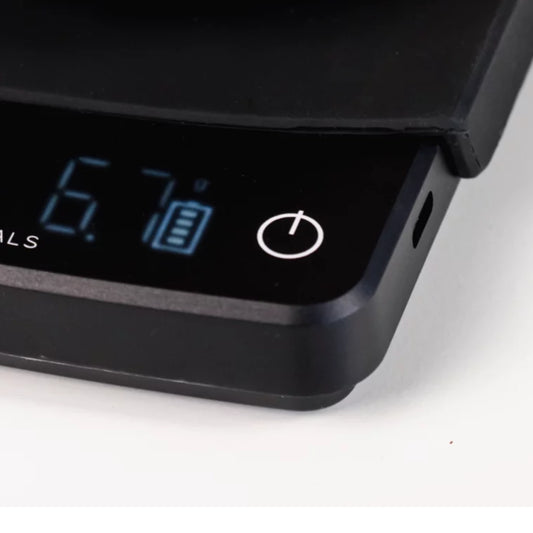
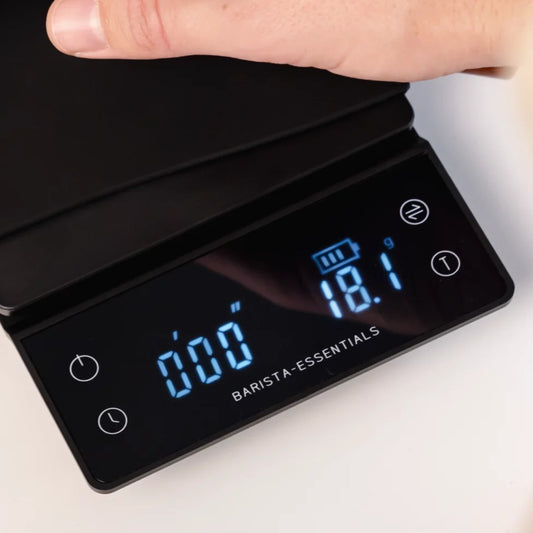
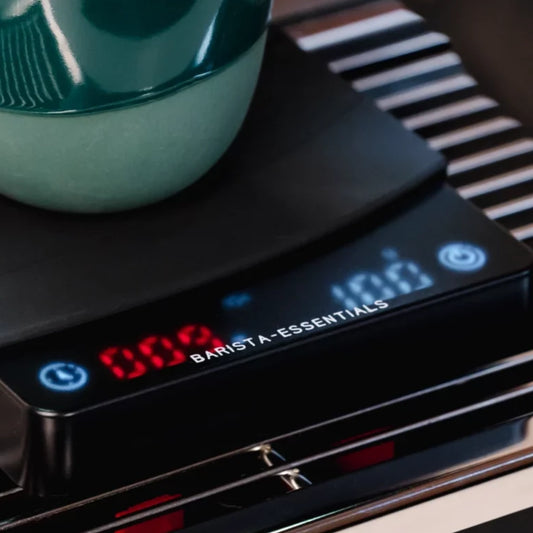
Step 2 – Always weigh your coffee (consistency)
This is a step that is often skipped, but is essential.
By weighing your ground coffee, you ensure you use exactly the same amount every time. Think of it like making lemonade:
- the same glass
- the same amount of water
- the same amount of syrup
Only then will you get the same taste every time.
In this case, your ground coffee is the "syrup." Not weighing it means guessing—and guessing means inconsistent espressos.
Step 3 – Place the filter holder correctly
After grinding and dosing, place the filter holder firmly in the brewing unit of the espresso machine.
Make sure it is properly secured before you start brewing, so that there is no loss of pressure.
Step 4 – Check the output (water quantity)
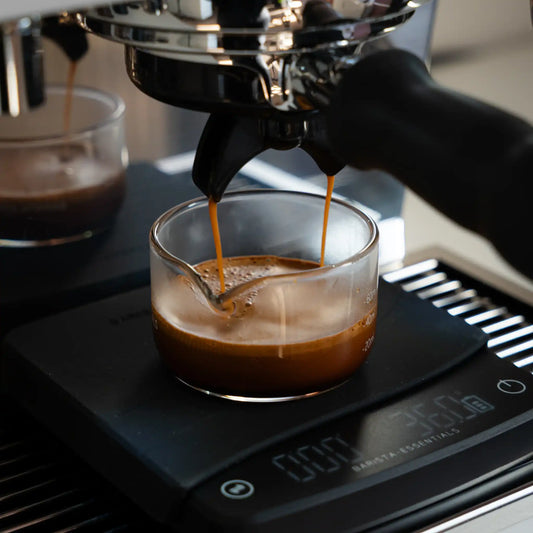
The output is the amount of water that flows through the coffee grounds. Just like with the dosage, this amount should be consistent every time .
You can measure this with:
- a shot glass
- a scale
- and by programming the water buttons on your machine
Step 5 – Guidelines for the correct output
Use these standard guidelines as a starting point:
- Single espresso: ± 30 ml
- Double espresso: ± 60 ml
These volumes ensure a balanced extraction, provided the grind and flow time are correct.
Step 6 – The brewing time: the key to a good espresso
This is the third golden rule of consistent espresso.
Start counting as soon as the water starts running .
-
Ideal lead time: 25–30 seconds
(for example: 18 grams in → 60 ml out)
What does an irregular time mean?
-
Less than 25 seconds
→ grind is too coarse
→ finer your grind
→ water flows more slowly
→ lead time increases -
Longer than 30 seconds
→ grind is too fine
→ set your grind coarser
→ water flows faster
→ lead time decreases
Always adjust one variable at a time : the grind size.
To know How to adjust your espresso machine or coffee grinder? Check out the digital checklist for your brand!
Conclusion: this is how you make a good espresso every day
A good espresso is all about control and repetition:
- Correct dosage
- Always weigh
- Correct placement of the filter holder
- Fixed output
- Correct ratio
- Duration between 25–30 seconds
Master these steps and you'll stop making "lucky shots" — you'll be making consistent, flavorful espresso every day .
☕ Frequently Asked Questions about Espresso Extraction
1. Why does my espresso sometimes taste good and other times sour or bitter?
This is almost always due to inconsistency in one of these three factors:
- Dosage (how many grams of coffee do you use?)
- Output (how many ml or grams of espresso comes out?)
- Turnaround time (how long does the extraction take?)
If any of these three changes, your extraction will change—and therefore your flavor.
Espresso is physics under pressure. Small deviations instantly produce different results.
2. Do I really have to weigh my ground coffee every time?
Yes.
Without weighing, you don't know whether you're using 16, 17, or 19 grams. It may not seem like much, but with espresso, it's a huge difference.
1 gram deviation changes:
- the resistance in the filter basket
- the lead time
- the taste balance
Weighing isn't perfectionism. It's control.
3. What is more important: measuring milliliters or weighing what comes out?
Weighing what comes out is more accurate.
Why?
Milliliters measure volume. But espresso contains crema (air). That affects the volume.
A scale measures mass (grams).
That's more objective and consistent.
Rule of thumb for beginners:
- 18 grams in → about 36 to 40 grams out (1:2 ratio)
Your blog uses 60ml as a guideline for a double espresso — that works well as a practical starting point, as long as you stay consistent.
4. My flow time is good (25–30 seconds), but the taste isn't right. What should I do?
Then it is probably not due to your grind size, but to:
- The freshness of your beans
- The surf (light vs. dark)
- The ratio between in and out
- Or your tamping (pressure and distribution)
Lead time is a guideline, not a holy grail.
Taste always remains the final check.
5. When should I adjust my grind size?
Whenever your lead time deviates from 25–30 seconds.
-
Too fast (<25 sec) → grind finer
-
Too slow (>30 sec) → grind coarser
Important:
Always adjust only one variable at a time.
Do not change both the dosage and the grinding degree.
6. What happens if I use more coffee than my filter basket can handle?
Then you get:
- Poor flow
- Channel formation (water seeks one path)
- Irregular extraction
- Bitter or tart flavors
Your filter basket has a maximum capacity.
Respecting this is crucial for balance.
7. Can I also use this step-by-step plan on a Sage, ECM, Rocket or Rancilio?
Yes.
The extraction principle is universal:
- Dosage
- Output
- Lead time
- Grinding degree
Whether you are working with a thermoblock (like many Sage models) or a boiler (like ECM or Rocket), the physics remains the same.
The way you set it up varies by brand — but the fundamentals remain the same.
8. What's the fastest way to get my espresso consistent every day?
Always follow the same order:
- Dose correctly
- Weigh
- Place correctly
- Measure output
- Check time
- Adjust only the grind size
Consistency comes from repeating the exact same steps.
9. How do I know if my espresso is under- or over-extracted?
Under-extraction (too fast, too acidic):
- Slightly acidic
- Thin mouthfeel
- Tastes “empty”
Over-extraction (too slow, too bitter):
- Bitter
- Dry in the aftertaste
- Astringent feeling
Taste is your diagnostic tool.
10. How can I get a quick and concrete overview of all the steps in this blog?
Don't want to read the entire blog every time you're at your machine?
Then a brand-specific espresso adjustment checklist is the fastest solution.
Per brand (such as Sage, ECM, Rocket or Rancilio) you will find:
- Exact dosage guidelines
- Output ratios
- Time control
- Concrete grinding degree adjustments
- Practical step-by-step overview in logical order
This means you don't have to guess, but you work with a clear, checkable system.
👉View the digital espresso adjustment checklist for your brand in the shop.