A well-adjusted coffee grinder makes the difference between taste and speed

The espresso tastes good in the morning, but suddenly sour or bitter later in the day.
The lead time varies, even though no one has changed anything.
And when it's busy the bar gets stuck, without it being clear why.

In many catering establishments the cause is sought in the espresso machine or the coffee beans.
But in practice the problem almost always lies somewhere else: the coffee grinder .

Close-up van een professionele koffiemolen in de horeca, waarbij precisie en afstelling bepalend zijn voor smaak, doorlooptijd en snelheid tijdens espresso service.

The coffee grinder: the most underrated appliance in the hospitality industry

The coffee grinder determines how water and coffee meet.
A minimal deviation in grind has direct consequences for:

  • taste balance (sour, bitter, body)
  • espresso flow time
  • speed during service
  • waste of coffee

Yet the mill is often seen as a given: “Isn't it in the right place?” And that is precisely where things go wrong.

Why Espresso Suddenly Tastes Different

Coffee is a natural product and continuously reacts to its environment.
Even without anyone realizing it, the extraction changes by:

  • temperature differences during the day
  • humidity
  • aging coffee beans
  • wear or contamination of the mill

If the grind isn't adjusted accordingly, you'll get inconsistent results — even if you do everything else the same.

The result: espresso tastes different every time , with no clear explanation.

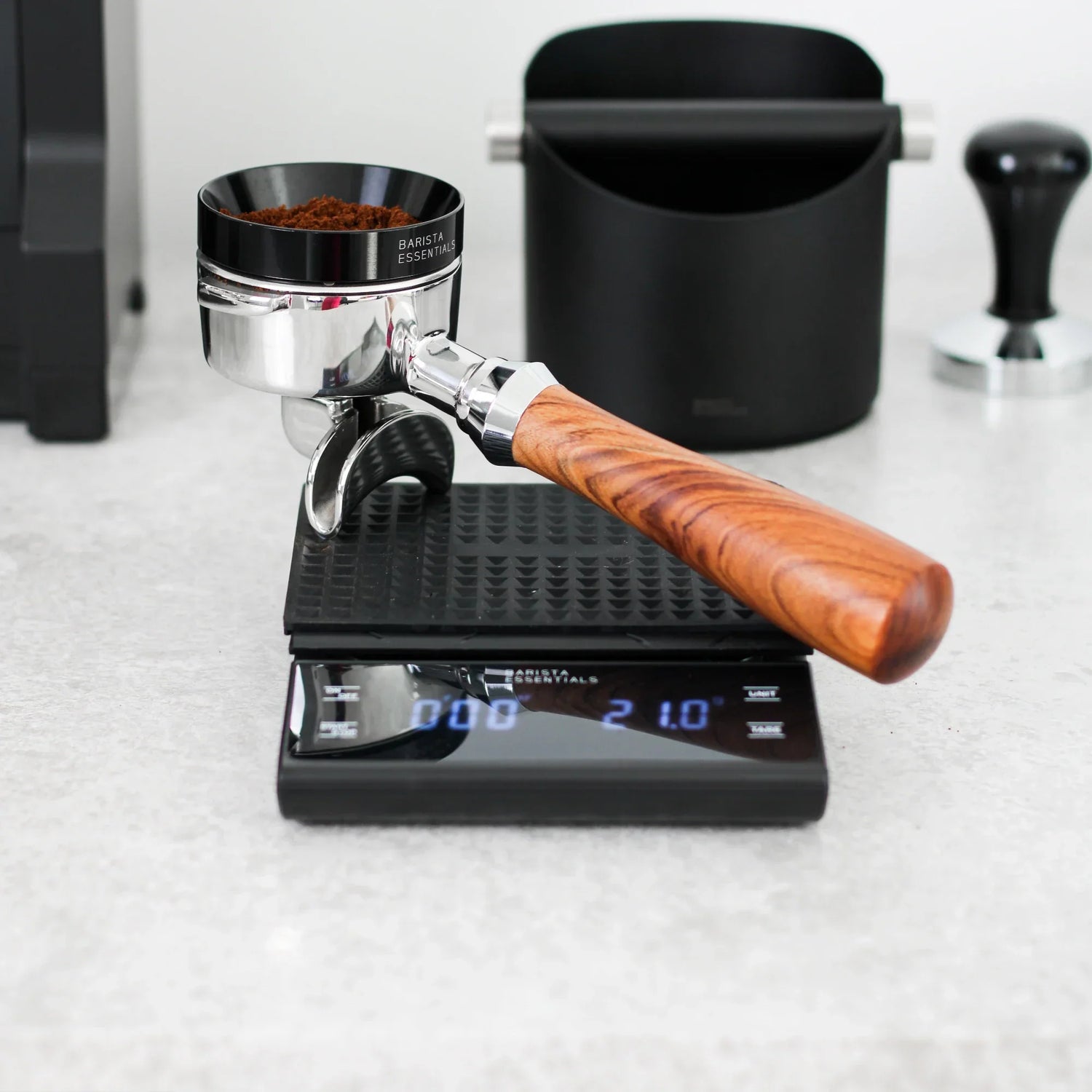
De koffie weegschaal met timer functie van Barista Essentials helpt de thuis barista met precisie koffie te bereiden. Door de koffie in je filterdrager of filterkoffie dripper te wegen, hou je de controle over de extractie van jouw favoriete koffie. Deze weegschaal maakt jouw filterkoffie en cappuccino helemaal af.

Varying lead times: frustration behind the bar

An espresso that runs in 25 seconds one time and 18 or 35 seconds the next, ensures:

  • stress during service
  • unnecessary adjustment "by feeling"
  • confusion within the team
  • inconsistent taste for the guest

Often attempts are made to solve this by tapping harder, working faster or ignoring settings.
But without understanding the coffee grinder, this remains symptom management.

A scale with a timer is exactly the instrument that replaces feeling with measurability.

Without a fixed measurement, lead time remains something that's 'approximately right.' Teams will adjust based on feeling, with varying results.

Hand die espresso aandrukt met tamper op siliconen tamping mat tijdens thuisbarista voorbereiding

What the hospitality industry often gets wrong

When problems with taste and speed keep recurring, you often see these reflexes:

  • replace beans
  • adjusting a recipe without providing justification
  • leave settings as they are
  • assuming that experience is enough

What is missing is the knowledge of the tuning itself – and especially: who does it, when and why.

Close-up van het maalsysteem van de Sage Oracle Jet espressomachine met verse koffiebonen in de molen, gebruikt ter illustratie van de stap-voor-stap handleiding voor het instellen van de juiste maalstand.

What properly adjusting the coffee grinder really means

A properly adjusted coffee grinder ensures:

  • stable lead time
  • predictable taste
  • less waste
  • work faster during peak times

But more importantly, it gives the team control .

When employees understand:

  • what they change,
  • why they do that,
  • and what the effect is on taste ,

the guesswork disappears and there is peace behind the bar.

Latte art in een handgemaakt 250 ml latte kopje in terracotta pink. Perfect voor barista’s thuis met een espressomachine van Sage of Philips met stoompijpje. Dunwandig keramiek voor optimale warmtegeleiding en stijlvol in elk interieur.

Why This Doesn't Work with Explanation Alone

You don't learn tuning from a manual.
And not by looking once.

In practice it only works when:

  • employees run the mill themselves
  • allowed to make mistakes under supervision
  • adjustment is linked to taste
  • everything is done on our own equipment

Only then will the puzzle fall into place.

Workshopdeelnemers oefenen met espressomachines onder begeleiding van een professionele barista in Amsterdam.

Practical guidance on the work floor

At De Barista Shop this problem is addressed with targeted on-site coffee grinder training , supervised by Geertjandebaristaman .

No general theory, but practical guidance on:

  • your coffee grinder
  • your coffee beans
  • your workflow
  • your pace

This way, teams not only learn how to adjust, but also when and why .

Read more: Barista workshop on location

Taste, speed and waste come together here

The coffee grinder is not an afterthought.
It is the heart of consistent espresso in the hospitality industry.

Who has control over this:

  • works faster,
  • waste less,
  • and serves coffee that's right every time.

👉 In the hospitality industry, the coffee grinder is often underestimated — while this is where taste, speed and waste come together.

Drukke horeca-espressobar waar barista’s tijdens piekmomenten espresso bereiden, illustrerend waarom een goed afgestelde koffiemolen essentieel is voor consistente smaak en snelheid.

Why properly adjusting a coffee grinder is essential for taste and speed

A well-adjusted coffee grinder makes the difference between taste and speed

The espresso tastes good in the morning, but suddenly sour or bitter later in the day.
The lead time varies, even though no one has changed anything.
And when it's busy the bar gets stuck, without it being clear why.

In many catering establishments the cause is sought in the espresso machine or the coffee beans.
But in practice the problem almost always lies somewhere else: the coffee grinder .


The coffee grinder: the most underrated appliance in the hospitality industry

The coffee grinder determines how water and coffee meet.
A minimal deviation in grind has direct consequences for:

  • taste balance (sour, bitter, body)
  • espresso flow time
  • speed during service
  • waste of coffee

Yet the mill is often seen as a fixed feature:
“Doesn't that look good?”

And that is exactly where things go wrong.


Why Espresso Suddenly Tastes Different

Coffee is a natural product and continuously reacts to its environment.
Even without anyone realizing it, the extraction changes by:

  • temperature differences during the day
  • humidity
  • aging coffee beans
  • wear or contamination of the mill

If the grind isn't adjusted accordingly, you'll get inconsistent results — even if you do everything else the same.

The result: espresso tastes different every time , with no clear explanation.


Varying lead times: frustration behind the bar

An espresso that runs in 25 seconds one time and 18 or 35 seconds the next, ensures:

  • stress during service
  • unnecessary adjustment "by feeling"
  • confusion within the team
  • inconsistent taste for the guest

Often attempts are made to solve this by tapping harder, working faster or ignoring settings.
But without understanding the coffee grinder, this remains symptom management.


What the hospitality industry often gets wrong

When problems with taste and speed keep recurring, you often see these reflexes:

  • replace beans
  • adjusting a recipe without providing justification
  • leave settings as they are
  • assuming that experience is enough

What is missing is the knowledge of the tuning itself – and especially: who does it, when and why.


What properly adjusting the coffee grinder really means

A properly adjusted coffee grinder ensures:

  • stable lead time
  • predictable taste
  • less waste
  • work faster during peak times

But more importantly:
it gives the team control .

When employees understand:

  • what they change,
  • why they do that,
  • and what the effect is on taste ,

the guesswork disappears and there is peace behind the bar.


Why This Doesn't Work with Explanation Alone

You don't learn tuning from a manual.
And not by looking once.

In practice it only works when:

  • employees run the mill themselves
  • allowed to make mistakes under supervision
  • adjustment is linked to taste
  • everything is done on our own equipment

Only then will the puzzle fall into place.


Practical guidance on the work floor

At De Barista Shop this problem is addressed with targeted on-site coffee grinder training , supervised by Geertjandebaristaman .

No general theory, but practical guidance on:

  • your coffee grinder
  • your coffee beans
  • your workflow
  • your pace

This way, teams not only learn how to adjust, but also when and why .


Taste, speed and waste come together here

The coffee grinder is not an afterthought.
It is the heart of consistent espresso in the hospitality industry.

Who has control over this:

  • works faster,
  • waste less,
  • and serves coffee that's right every time.


👉 In the hospitality industry, the coffee grinder is often underestimated — while this is where taste, speed and waste come together.

See how targeted on-site coffee grinder training solves this problem →

Back to blog

Leave a comment

Please note, comments need to be approved before they are published.