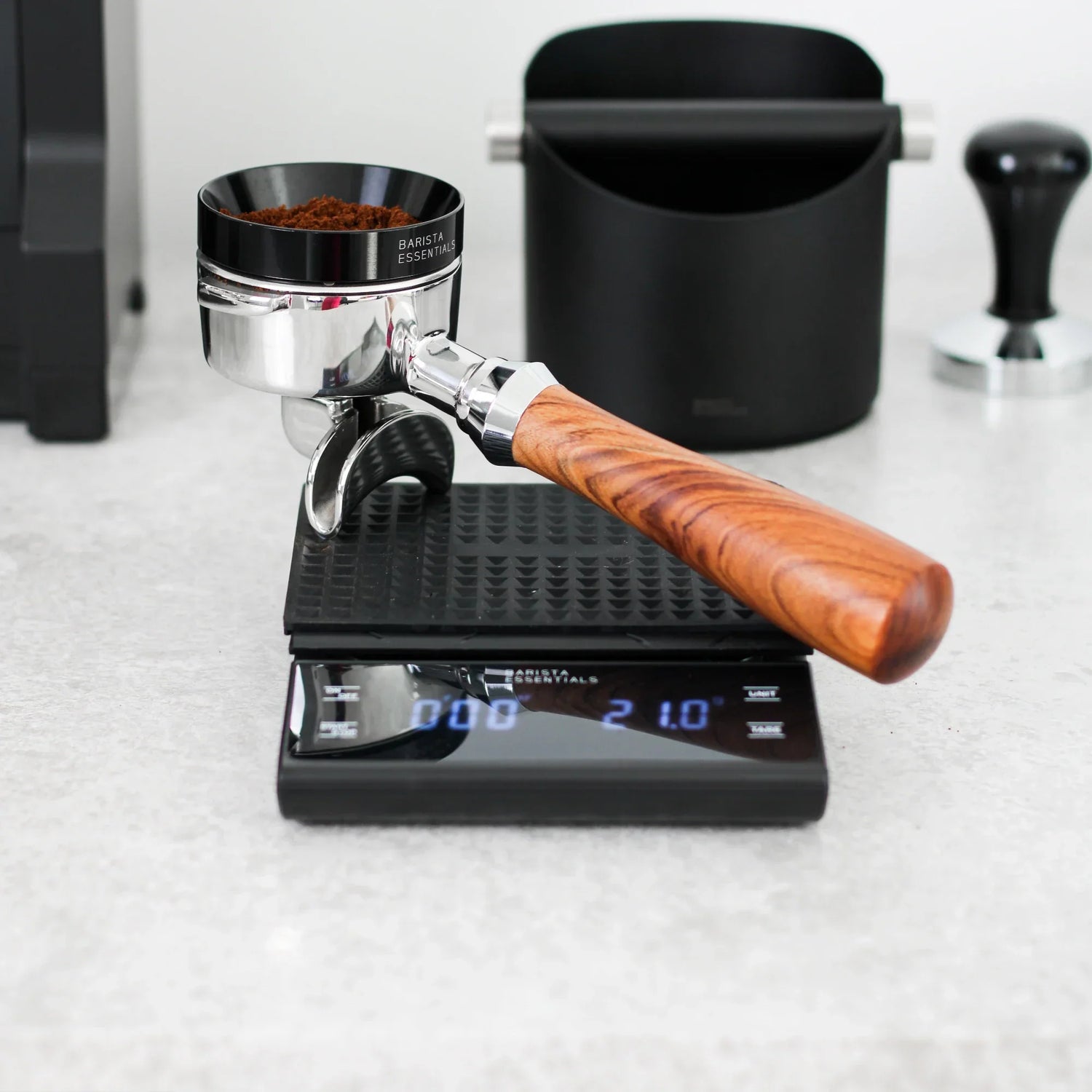
Espresso spouts from your Naked filter holder? Discover causes, solutions, and tips.
To share
Why Is My Espresso Spouting Out of My Naked Portafilter? Here's Why (and How to Fix It)
You just got your espresso machine and are using a naked (bottomless) filter holder. It's ideal because you can see exactly what's happening in the puck. Less ideal: small streams shooting out in all directions. Don't panic—this is purely feedback. Below you'll find more information.
- A clear explanation of what is happening
- The 5 most common causes
- A clear step-by-step checklist
- Subtle, practical tips for improvement
If your espresso is spouting from a naked portafilter (bottomless portafilter ), it's a sign that something is wrong with your puck preparation or machine settings. A naked portafilter immediately reveals how the extraction is going: nice and even, or messy and spouty.
Possible causes of spouting espresso:
1. Channeling (holes in the puck)
- Water seeks the path of least resistance.
- If there are cracks, air holes, or uneven spots in the coffee puck, water will flow through them with force and spray out.
2. Uneven tapping
- When your puck is pressed crooked or unevenly, a weak spot is created through which water shoots.
3. Wrong grind
- Too coarse: water flows through too quickly, which increases channeling.
- Too fine: blocks the puck, causing pressure to build and it escapes through a weak spot.
4. Uneven distribution of the coffee
- If there are lumps or voids in your filter basket (e.g. due to no WDT or poor distribution), you will not get an even extraction.
5. Too much or too little coffee in the filter holder
- Overdosing can cause the puck to press against the machine's shower plate and burst.
- Underdosing gives you space for water to accumulate and spray.
✅ What you can do to fix it:
- Ensure a consistent grind (experiment with the fineness).
- Use WDT (Weiss Distribution Technique) or shake/tap for even distribution.
- Tamp straight and firm , without skewing.
- Check your double espresso dose : usually 18–20 grams (depending on the brand of filter basket).
- Keep your machine clean : clean the shower tray and filter holder thoroughly to prevent build-up.
👉 A naked filter holder is essentially your "truth detector": spraying jets are annoying, but they help you immediately see where your puck preparation can be improved.
Step-by-step checklist: from bean to cup
1. Start with freshness
- Use fresh, whole-bean coffee (ideally 7–30 days after roast date for espresso).
- Older than ~8–10 weeks? Increased risk of a troubled extraction and splashing.
- Always store your coffee beans in a vacuum storage jar to slow down oxidation of the oils and fats in the beans
2. Grind consistently
- Adjust your grinder to achieve a brew ratio of approximately 1:3 in 25–32 seconds (e.g., 18 g in for a double espresso → 56–60 g out). A 1:2 ratio is often recommended online. However, in the many workshops I lead, I've noticed that coffee enthusiasts achieve much better results with a 1:3 ratio.
- Record your settings so that you can make targeted adjustments.
3. Weigh your dose
4. Weigh in and out (dose and yield). This way, you'll be managing based on facts instead of gut feeling.
5. Distribute evenly
- Break up lumps and fill cavities in the puck ( WDT or similar technique).
- Do not tap the side of the filter holder hard—this will create cracks.
6. Level & tamp right
- Flatten the top ( distributor /leveler), tamp straight with constant pressure.
- Prevent the puck from being lower on one side.
7. Check headspace
- After tamping, the puck must not press against the shower plate.
- Overdosing = crack formation → sprayers.
8. Rinse and clean
- Rinse the group head briefly, clean the shower plate and your portafilter .
9. Start the shot & observe
- Early bursts of urine from one spot? The cause is often distribution/tamp.
- Trouble after 20–25 seconds? Check your grind and total runtime.
10. Evaluate and adjust
- Too fast → grind finer or dose slightly higher.
- Too slow → grind coarser or dose slightly lower.
- Skewed beam → correct distribution/tamp.
Maintenance rhythm
Clean your grinder and machine regularly; consistency starts with clean tools.
The 5 most common causes
1) Beans no longer fresh or unsuitable
Older or overly oily beans often result in a choppy, spurting extraction. Freshly roasted, suitable espresso beans deliver a more stable flow and a more beautiful crema.
Tip: Upgrade your base. Buy fresh beans from Barista Essentials for a consistent start.
2) Uneven tamping or insufficient leveling
( leveling = distributing the coffee in your filter holder horizontally and evenly for an even extraction )
A crooked or uneven puck creates a weak spot through which water shoots—classic channeling with splashes.
Tip: Work neatly and reproducibly. Use a tamping station and a Barista Essentials coffee dispenser for straight, even, and repeatable tamping.
3) Grinding (and grinder) not in order
Grinding too coarsely, too finely, or inconsistently causes pressure spikes or "rapid runs" through the puck. Dirt and retention in your grinder make matters worse.
Tip: Keep your grind system fresh. Clean your grind system (burrs, chute) regularly to ensure consistent grinding.
4) Uneven distribution, lumps and voids
Lumps or cavities create micro-channels through which water sprays with force.
Tip: Break up any lumps and fill any cavities. Use a Barista Essentials WDT tool for a smooth, airy puck.
5) Wrong dose or ratio
Too full (puck hits shower tray) → cracks; too empty → water builds up speed and seeks outlets. Without a scale, this is guesswork.
Tip: Use figures. Use a scale to accurately replicate dose and yield (e.g., 18 g in → 36–40 g out).
Quick “symptom → action” guide
- Splashes right from the start: improve distribution/tamp; grind slightly finer.
- Beam is crooked from one side: re-level; tamp straight; check basket fill.
- Great start, chaos later: flow time too long → grind a little coarser or stop earlier.
- Bitter and dark, but still a splash: possibly overdosing or puck contact with shower plate → slightly less coffee and check headspace.
- Varying results per shot: consider freshness , grinder cleaning and scale (reproducibility).
Finally, make your naked portafilter a learning tool, not an enemy
A naked portafilter magnifies errors—and that's precisely its strength. By fine-tuning freshness, distribution, tamp, grind, dose , and maintenance , spraying disappears and you get that syrupy, honey-like stream that every home barista loves.