Making espresso at home: weighing, supporting and serving

Want to weigh your espresso, support your filter holder, and serve small amounts? My advice: start with a scale that fits under the spout along with your cup. Choose a station only if there is space under your filter holder; otherwise, a suitable mat can protect your countertop. Keep a well-fitting tamper that you already have. View the practical guide and dimensions below the products.

Advice from Geert-Jan de Baristaman β€” Specialty Coffee Trainer & Barista Coach (10+ years of experience).

Follow your shot from weighing to serving

A consistent approach starts by noting what you do. Weigh your ground coffee and the espresso in your cup, and write down the brew time. Use the dosing recommendation of your own filter holder as a starting point; 18 grams does not automatically fit in every holder. Also choose the same time to start your timer. Otherwise, you are comparing times that measure something slightly different. The scale selection guide goes into more detail about manual and automatic operation.

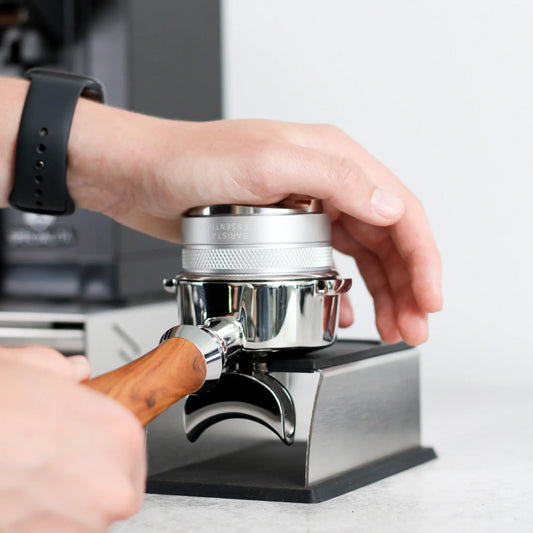
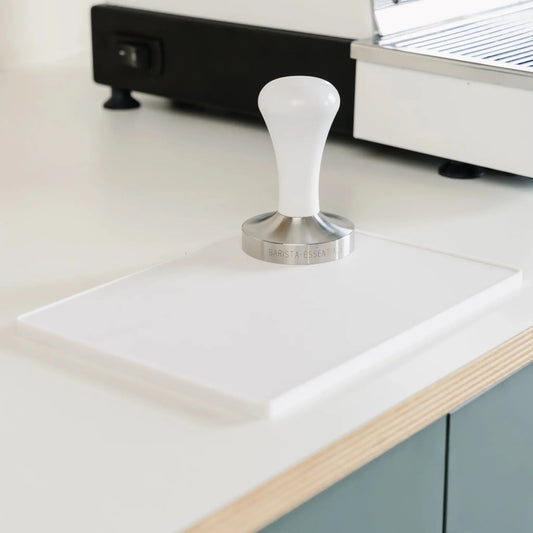
A station supports the filter holder during tamping, but does not tamp the coffee. Check the space under the spout of your filter holder. Do not buy a station yet if that fit is still unclear. The two colors have the same stated external dimensions; a silver version does not solve a fit problem of the black one.

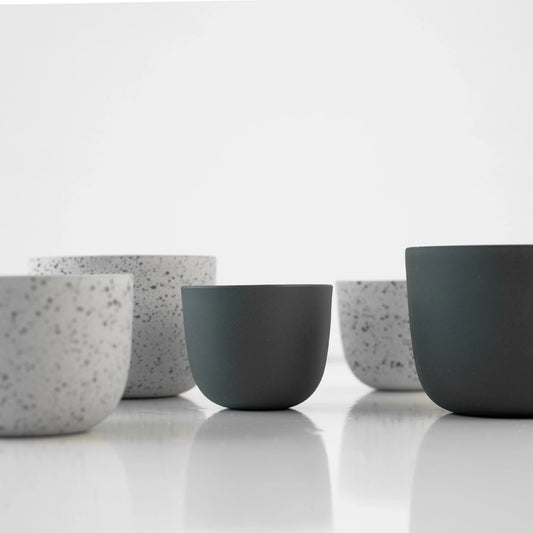
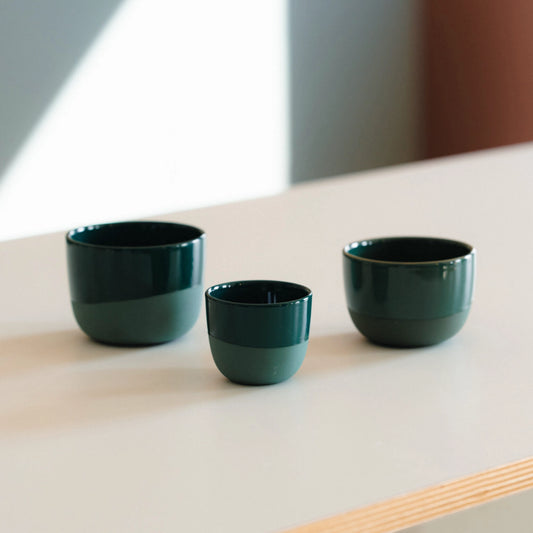
A 60 ml cup gives little room for a large drink. Weigh the espresso in grams; do not try to fill the whole cup because it says 60 ml. For larger milk drinks, you will find at the cups of 60, 180 and 250 ml other volume sizes. The colors are a choice in appearance, not a promise that your espresso will taste sweeter because of it.

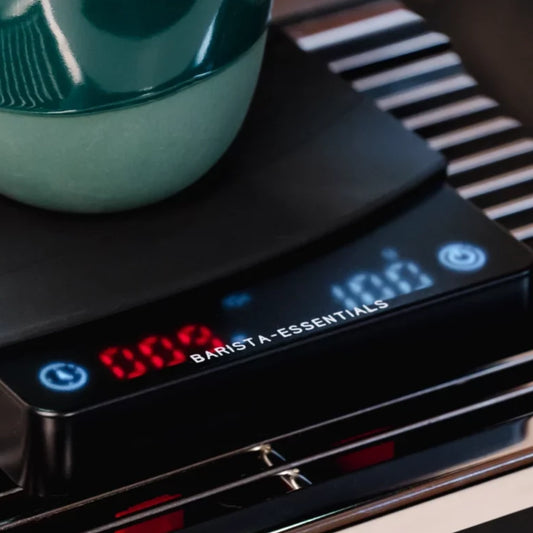
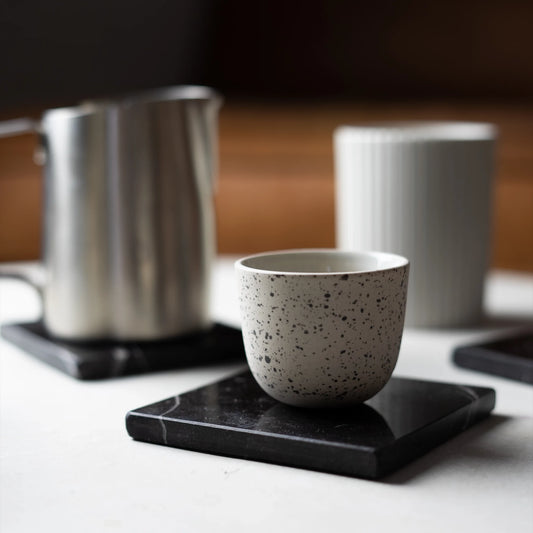
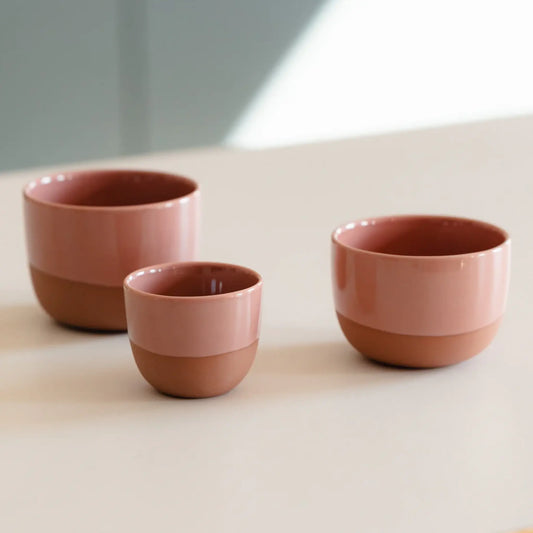
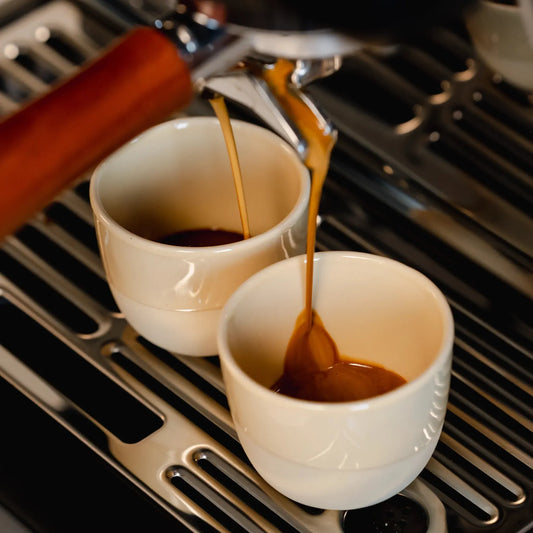
The usage photo shows weighing under a machine; it is not a fit guarantee or package content. Measure the actual free height and add the height of your cup to the scale. For the gray and dotted cup, that is 77 mm with the basic scale, 70 mm with the automatic and 69 mm with the mini based on the stated dimensions. Those are additions, not a confirmation of total working height including all mats or clearance. For the half-glazed cups, a confirmed height is missing.

Geert-Jan works almost daily with Barista Essentials tools in workshops. Those who can already perform the measurements but still find the taste difficult can continue with The 3 Golden Rules of Espresso. It is then about understanding and practicing, not automatically buying another accessory. If you are starting completely from scratch, the beginner selection guide first helps determine what you already have.

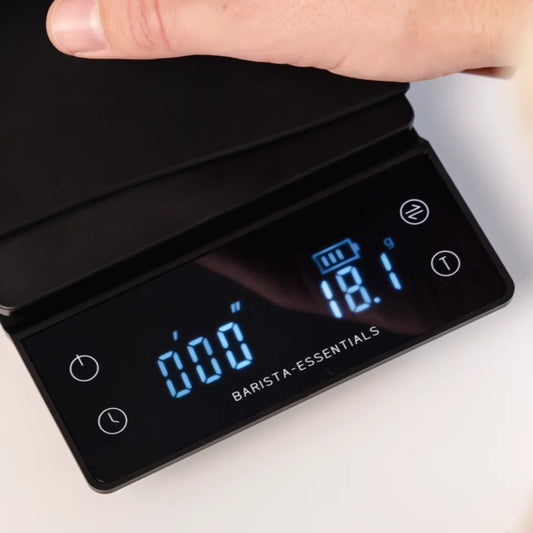
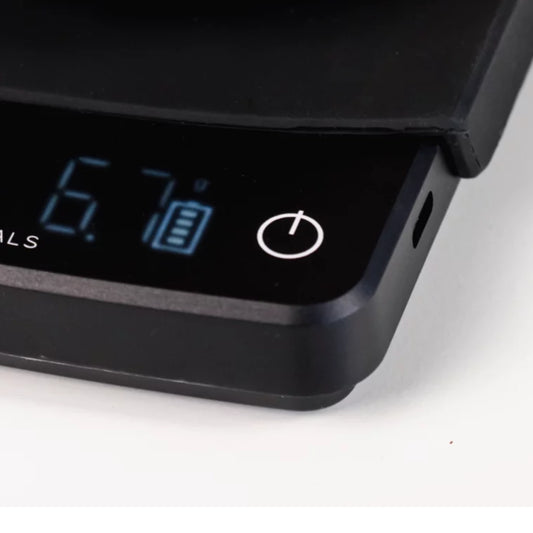
The three scales are USB-C rechargeable. The basic with manual timer measures 183 Γ— 129 Γ— 27 mm; the automatic version 128 Γ— 118 Γ— 20 mm; the mini with automatic timer 100 Γ— 95 Γ— 19 mm. Measure the free surface of your drip tray. Add the height of your own cup including handle or spout to the scale and check the spout clearance. That combination height is not confirmed for your machine. Keep the connection dry; a rechargeable battery is not automatically user-replaceable.

The two stations are made of folded steel with silicone non-slip and measure 15 Γ— 11 Γ— 6.7 cm. There must be free space between the spout and the underside of your filter holder. Original Sage and DeLonghi filter holders usually do not fit according to the supplier; a different color does not change that. The support is not a tamper and no promise of a better extraction.

The flat silicone mat is 20 Γ— 15 cm; the source mentions a thickness of 5 mm. The corner mats have a top surface of 140 Γ— 125 or 150 Γ— 205 mm and a source specification of 5 mm material thickness. The full external height of the folded part is not confirmed. Measure the edge of your countertop and lay the mat flat and stable. A mat protects the countertop; it does not tamp the coffee and does not solve an unsuitable filter holder support.

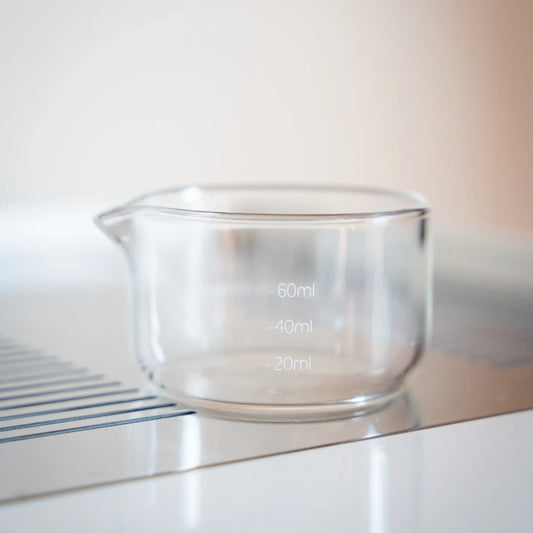
The shot glass has measurement lines, a handle and pouring spout for catching and pouring over. You still measure weight with the scale; crema does not make volume a fixed measure for the espresso yield. The source does not confirm a full external height and width including handle and spout. So check the spout clearance and preferably wash the glass by hand.

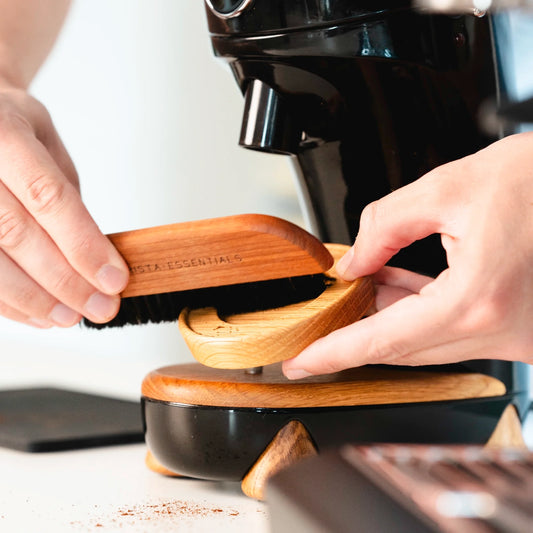
The wide wooden coffee brush is 13 cm wide, for dry, accessible grounds. Total depth and height are not confirmed. Do not use it as an internal grinder brush. Remove the filter holder with a separate brown cloth and use black around the machine.

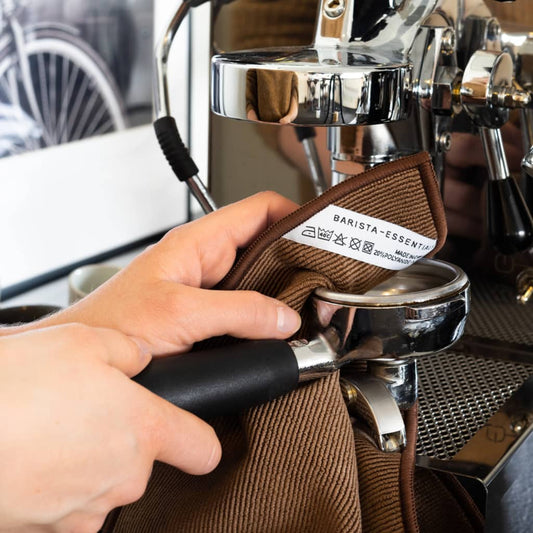
The brown and black color choices each contain two microfiber cloths of 30 Γ— 30 cm, 80% polyester and 20% polyamide. Wash at maximum 40 Β°C and do not use a dryer. They support the same brewing and cleaning action; milk accessories and other coffee steps are in their own routes.

Frequently Asked Questions

What is the difference between milliliters and grams of espresso?

Cup size is given in milliliters; the scale measures weight. Crema makes a volume measurement different from the measured weight. A 60 ml cup is therefore not a recipe for 60 grams of espresso. Follow your recipe in grams.

When should I choose a manual or automatic timer?

With the basic scale, you start the timer yourself. The automatic and mini models have an auto-timer and auto-tare. Choose a mode that you understand and check at what point the selected mode is used as the start. Always use the same timing method when comparing.

Does the tamping station fit my Sage or De’Longhi portafilter?

The supplier states that original Sage and De’Longhi filter baskets usually have insufficient clearance under the spout. Check your exact filter basket before ordering. The station is a support, not a universal holder or a tamper.

Do all five espresso cups have the same exterior dimensions?

All five are offered as 60 ml. Only for the original grey and speckled model are 50 mm height and 60 mm head diameter specified. The width including the handle is not specified separately; do not use these dimensions for the three half-glazed colors.

Do I need to buy all three scales and both stations?

No. These are alternatives. Choose at most what supports your missing step and keep suitable tools you already have. The colors of the station do not change the stated size. The machine, grinder, tamper and pictured accessories are not included as a complete package.

I have another question

Is your question not listed? Contact us. We are happy to help you choose the right product.

Collection: Making espresso at home: weighing, supporting and serving

Want to weigh your espresso, support your filter holder, and serve small amounts? My advice: start with a scale that fits under the spout along with your cup. Choose a station only if there is space under your filter holder; otherwise, a suitable mat can protect your countertop. Keep a well-fitting tamper that you already have. View the practical guide and dimensions below the products.

Advice from Geert-Jan de Baristaman β€” Specialty Coffee Trainer & Barista Coach (10+ years of experience).

Espresso in kopjes wegen onder een espressomachine; gebruiksfoto zonder pasgarantie