Barista tools: choose what helps your next move

Which tool helps with the step you want to improve? My advice: first choose that action and check what you already have. Weighing, distributing, tamping, and pouring milk each require something different. For a beginner who wants to use WDT, I recommend a tool with a holder and a suitable dosing ring, unless you already have one. Read the practical selection guide and dimensions under the products.

Advice from Geert-Jan de Baristaman — Specialty Coffee Trainer & Barista Coach (10+ years of experience).

Choose per action, check the execution

Start with a recognizable problem. If you want to know whether you use the same amount of coffee each time, weighing helps more than another distribution tool. If you spill when filling the filter basket, a suitable ring or catch cup may be relevant. By choosing one step, you can also better assess whether the change in your daily routine is useful.

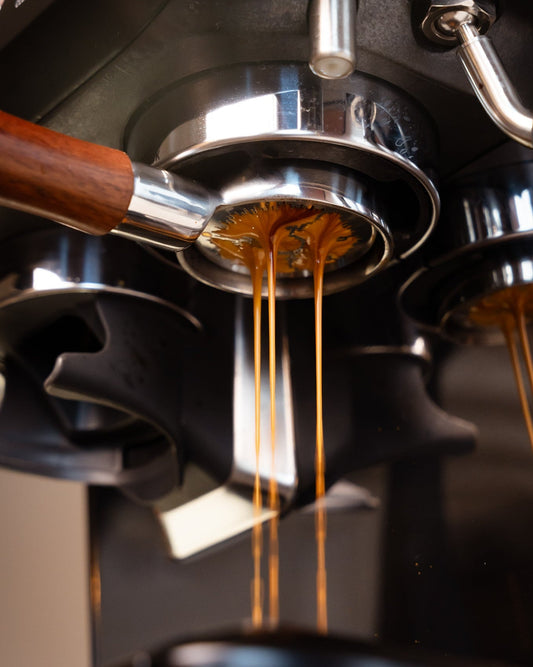
The different versions remain visible here because sizes, fit, and operation really make a difference. An open filter holder shows the flow; a filter holder with a double spout serves differently. That does not make one version inherently better. Read the model information before choosing a part for your machine and feel free to continue using a usable original part.

Distributing the grind and tamping properly

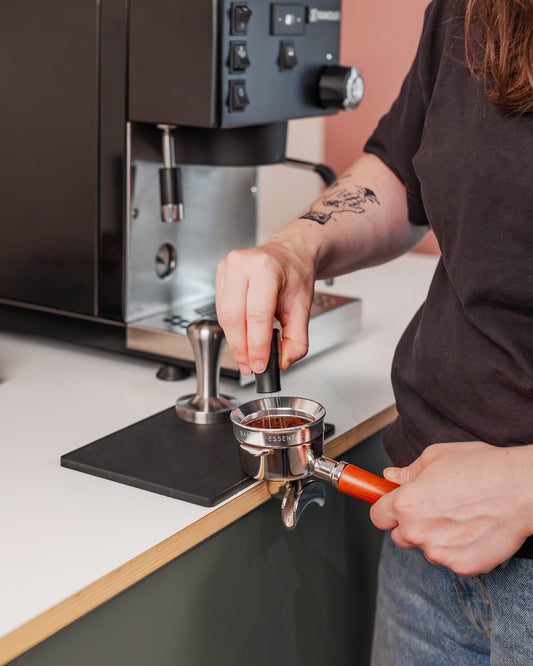
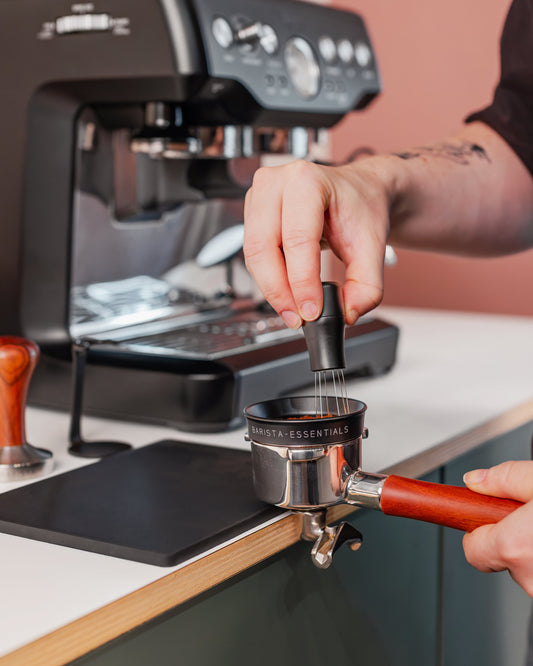
WDT breaks up clumps in fine espresso grind and distributes the coffee better, with less chance of channeling. Make small, gentle, controlled movements through the coffee. My advice for a beginner is a tool with a holder for a fixed storage place, plus a suitable dosing ring unless one is already there. A separate holder is for an existing suitable tool; a tool without a holder is not a complete combination with a fixed storage place. The aluminum tool has needles of 0.35 mm and replaceable needles. Total external dimensions of tool and holder are not fully confirmed.

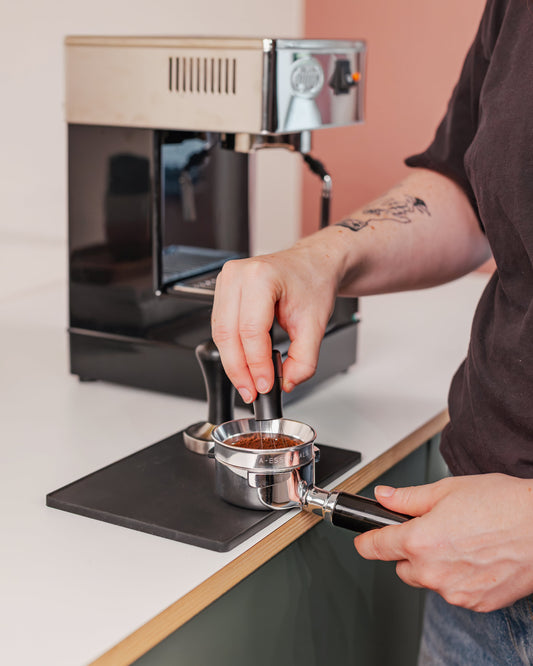
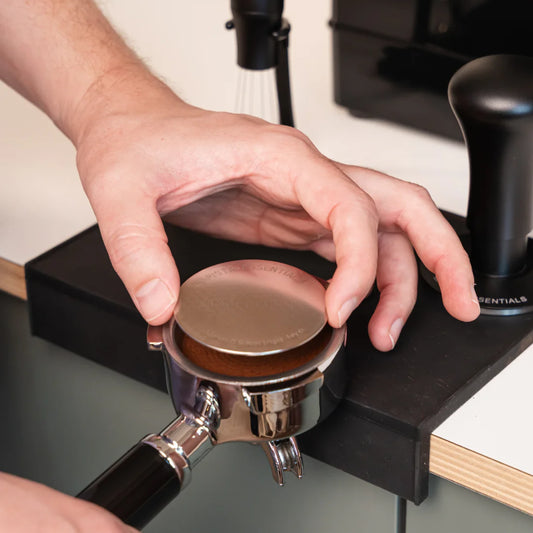
The click tampers are available in 51, 53.3, 58 and 58.5 mm, with a stainless steel tamping surface and a click specified by the supplier at 12 kg. That is an operating feature, not a guarantee of straight fit or better espresso. Hand tampers are separate alternatives; you do not need to buy both types. Check the actual filter basket: 49 or 51 mm is not 53.3 mm and 58 mm is not automatically 58.5 mm. The general tables mention 49 × 49 × 93, 51 × 51 × 93 and 58 × 58 × 93 mm; those specifications do not confirm all handle/size variants. The complete external height of the click tamper is not confirmed.

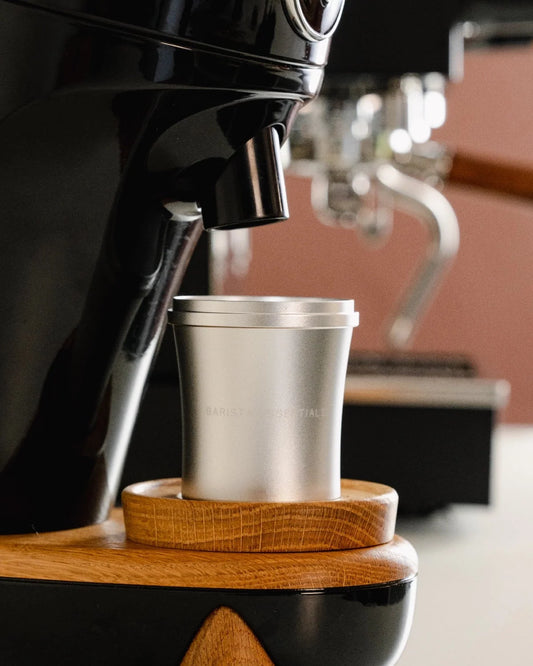
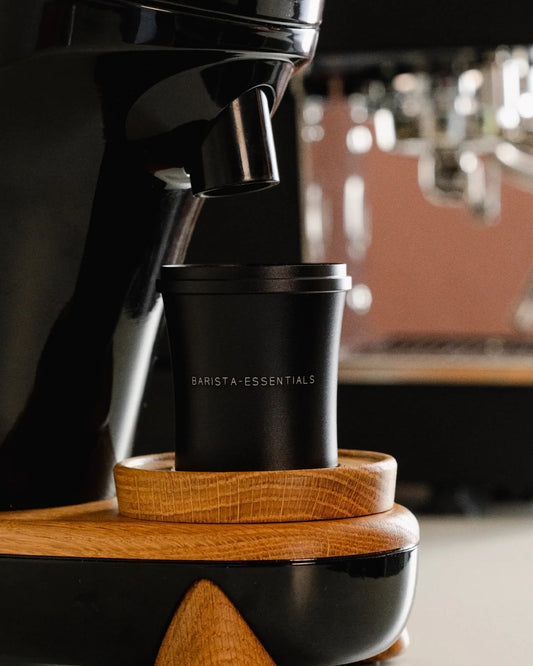
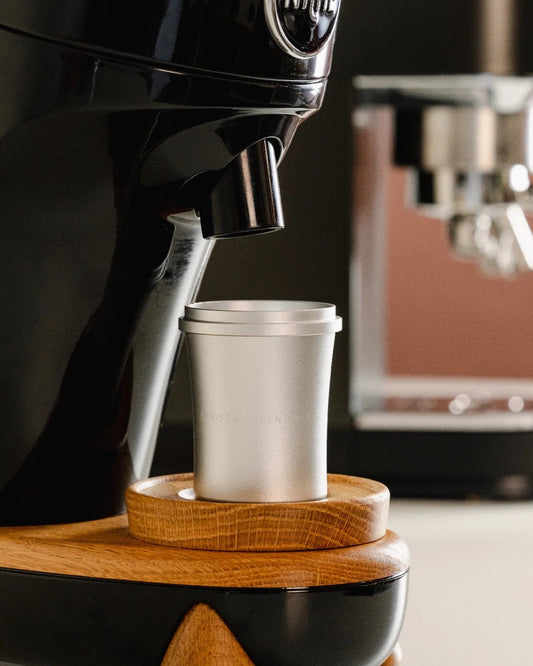
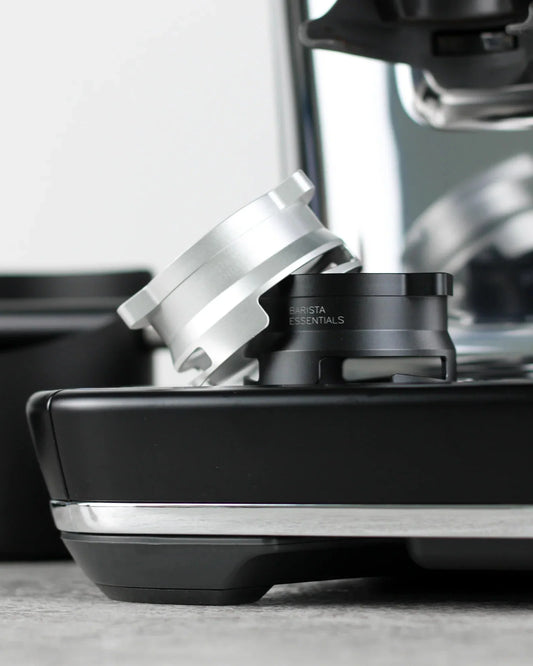
Dosing rings and cups help transfer the same grind. A ring stays on the filter basket during distribution and is removed before tamping; a dosing cup catches the grind separately first. Check the fit on both the grinder and filter holder. The separate rings are available in 51, 53.3, 58 and 58.5 mm; the Sage version has its own fit. General tables mention 51 × 51 × 22 mm for a ring and 54 × 54 × 34 mm for the Sage ring. Those specifications are not proof of the external dimension of all diameters. The Sage cup is specified as 54 × 54 × 85 mm and the Impress cup as 54 × 54 × 68 mm. For other cup versions, complete external heights are missing. A plain 54mm label does not prove fit on the Impress tamping system.

The three scales are USB-C rechargeable. The base with a manual timer measures 183 × 129 × 27 mm; the automatic version 128 × 118 × 20 mm; the mini with an automatic timer 100 × 95 × 19 mm. Measure the free surface of your drip tray. Add the height of your own cup including handle or spout to the scale and check the clearance. That combination height is not confirmed for your machine. Keep the connection dry; a rechargeable battery is not automatically user-replaceable.

A suitable mat and place for coffee pucks

For the flat mat, the description mentions 20 × 15 cm and 5 mm thick; the specification table deviates from that with 15 × 20 × 4 mm. Have the external dimension and thickness confirmed if they are decisive for your space. Corner mats are mentioned in the description as 140 × 125 and 150 × 205 mm and 5 mm thick; the table mentions 140 × 125 × 6 mm. So that thickness is also not unambiguously confirmed. Choose flat or corner according to your worktop and use a stable support.

The round containers are available with a diameter of 11 or 14 cm; the external height is not separately confirmed. The square container measures 16 × 16 × 12 cm. Ensure there is space above every container to move the filter holder. Empty and clean the container regularly and also clean the removable rod. A separate container is not a support surface for a coffee grinder.

For the mini knock box, the supplier mentions 28 × 18 × 6 cm. Check the dimensions and load of the exact version before you put a grinder on it; the table is not proof of fit for every drawer variant or grinder. The separate spare rod in this selection is the version for the Mini knock box and not for all containers.

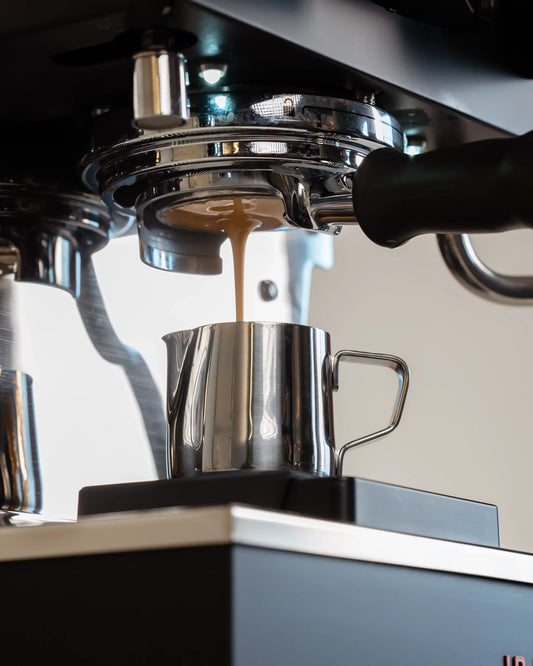
The Italian stainless steel pitchers have a sloping top and raised spout, with existing choices of 350, 500 or 750 ml. The Essentials series has a narrower pouring spout and choices of 350 or 550 ml. Not every size is available in every color as a separate product. Capacity is not filling advice: leave room for milk to move. External height and total width including handle and spout are not confirmed. Check that space at your steam pipe. The supplier mentions both series as dishwasher safe; follow the instructions of your version. The separate MFC milk cleaner contains twelve sachets of 10 grams and supports the same milk operation; use it according to the medium and machine instructions, without a universal cleaning schedule.

The separate color choices each contain two cloths; the set of six contains two gray, two brown and two black. Each cloth measures 30 × 30 cm and consists of 80% polyester and 20% polyamide. Keep gray for the steam pipe, brown for the filter holder and black for the surroundings of the machine. Wash at maximum 40 °C, do not use a dryer and let the cloths dry well. A clean cloth does not replace a cleaning agent for the inside of your device.

Choosing maintenance on the manual

The wooden coffee brush is 13 cm wide for dry loose grounds; complete depth and height are not confirmed. The group head brush has a replaceable head and dosing scoop. The packaging spare heads contains five for the intended Barista Essentials brush; complete brush external dimensions are not confirmed. Follow the machine instructions for hot parts.

Cafetto EVO contains twelve bags of 5 grams for coffee residues; MFC twelve of 10 grams for milk residues; Renew four of 25 grams for limescale; Grinder Clean three of 15 grams for a suitable grinder. Those agents are not interchangeable. The machine manual and the agent determine application, dosage, rinsing and frequency. Backflush only if your machine allows it. There is no universal monthly or three-monthly schedule.

Choosing parts for your existing filter holder

Filter holders and baskets are targeted replacement or experimental choices. The connection and lugs must fit the exact machine model; a diameter alone does not confirm that. The standard stainless steel single-wall baskets are available in 51, 54 and 58 mm; the supplier mentions 16–20 grams as a range. For 51 mm, the table specifies 51 × 51 × 25 mm. Those external dimensions do not automatically apply to 54 or 58 mm. For an original De’Longhi Dedica filter holder, the supplier mentions the plastic insert as a point of attention: first check the model instructions and required free space.

The precision baskets are available in 51, 54 and 58 mm, with one or two layers. The supplier mentions 17–19 grams and a built-in filter layer of 0.18 mm for the two-layer version. External heights and rim dimensions are not fully confirmed. Convex baskets are deeper and only intended for a suitable naked filter holder: 54 mm tapers according to the supplier to 32 mm, 33 mm deep, with 16–18 grams as the specified range; 58 mm tapers to 34 mm, 38 mm deep, with 18–22 grams. These are source specifications to check the choice, not a mandatory recipe or guarantee of taste. A suitable existing basket does not need to be replaced.

The handleless stainless steel milk pitcher has 400 ml capacity to the rim and a removable silicone cover; external dimensions are missing. For silver, according to the supplier, the cover may come off in the dishwasher. Black and white you clean by hand and with a soft sponge. Another grip is an option to practice with, not a necessary step for every beginner.

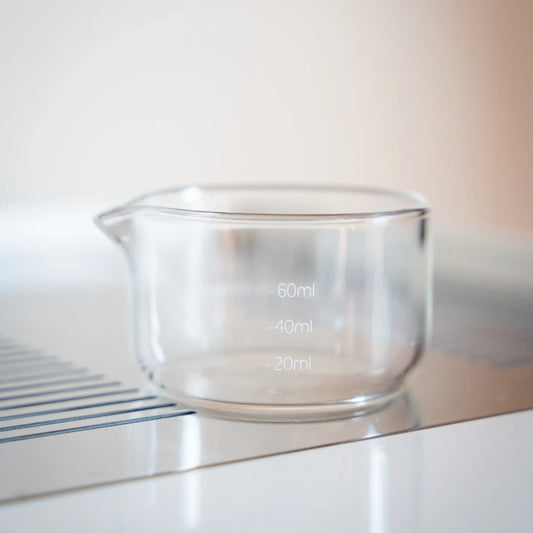
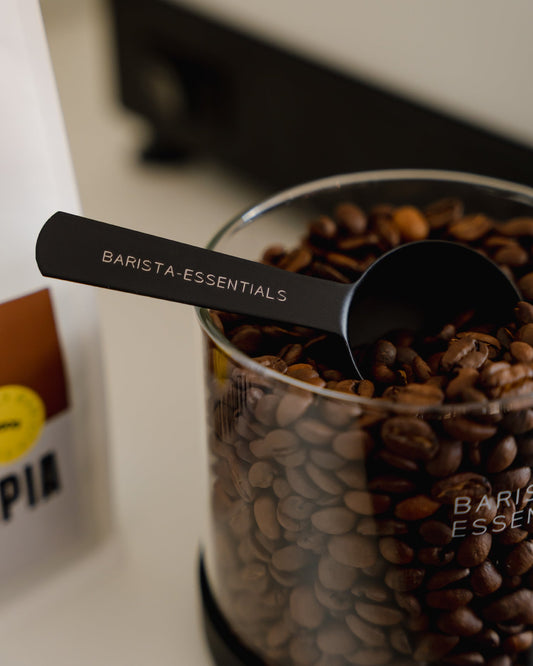
For transferring beans, the stainless steel scoop is specified as 103 × 41 × 25 mm. Weigh the dosage separately; a full scoop does not always have the same weight. The stainless steel espresso pitcher has 100 ml capacity and a spout. The complete external dimensions including spout are not confirmed. The supplier mentions dishwasher suitability; the separate shot glass requires hand washing. Only choose a catch form that fits on your scale and under the spout.

The containers are for approximately 250 or 500 grams of whole beans, not for ground coffee. Lite and Pro close with an electronic vacuum lid; Pro adds a date indicator and readout of temperature and humidity. Glass lets light through and you store it dark; stainless steel shields light. The confirmed diameter is 10 cm. Total heights with the lid and required lifting space are not confirmed. Do not choose a larger container just because it is available. Use USB-C with 5 V and 1 A for charging and keep the lid away from water. There is no fixed extra storage time or replaceable battery confirmed.

On this overview page, the main tools are first and supporting rings, cups, mats, storage and maintenance choices afterwards. The wide choice is not a shopping list. A storage container stores beans; water filters and gifts have a different purchasing question. For a gift package, use the gift choice aid. There is no result or extraction guarantee associated with a tool.

Frequently Asked Questions

Do I need all these tools?

No. First, choose the aspect you want to change and check what you already have. With a scale and a suitable tamper, you can already compare a lot. An additional distributor, open portafilter, or screen is a targeted next step, not a requirement for every home barista.

What is the difference between a WDT and a coffee distributor?

A WDT tool has thin needles that break up clumps in the ground coffee before tamping. A distributor works on the surface; a combination tool also has a side for pressing down. They do not automatically replace each other's function. Check the correct size and setting.

Does a 58 mm part fit every 58 mm machine?

No. The size of a tamper or screen refers to the fit in the filter basket. With a portafilter, the lugs and the connection to the group head also matter. Check the exact model, the basket used, and the available space; 58 and 58.5 mm are also different options.

Which scale should I choose?

Compare the controls and size. The basic scale has a standard timer and measures 183 × 129 × 27 mm. The mini with an automatic timer is 100 × 95 × 19 mm; the larger automatic timer model is 128 × 118 × 20 mm. When measuring the scale height, add the height of your cup and measure the space under the spout.

Which maintenance tool is used for which task?

A brush sweeps away accessible grounds, while wipes are used separately for each task. Cleaning products for coffee oil, milk, limescale, and grinders each serve a different purpose. Follow the instructions for the machine and the cleaning product. Not every machine can be backflushed or treated with the same descaler.

I have another question

Is your question not listed? Contact us. We are happy to help you choose the right product.

Collection: Barista tools: choose what helps your next move

Which tool helps with the step you want to improve? My advice: first choose that action and check what you already have. Weighing, distributing, tamping, and pouring milk each require something different. For a beginner who wants to use WDT, I recommend a tool with a holder and a suitable dosing ring, unless you already have one. Read the practical selection guide and dimensions under the products.

Advice from Geert-Jan de Baristaman — Specialty Coffee Trainer & Barista Coach (10+ years of experience).

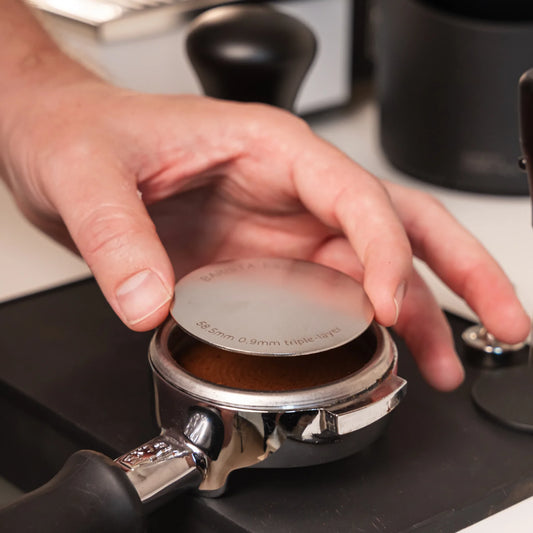
Hand houdt een koffieverdeler boven een filterdrager op een zwarte tampingmat